
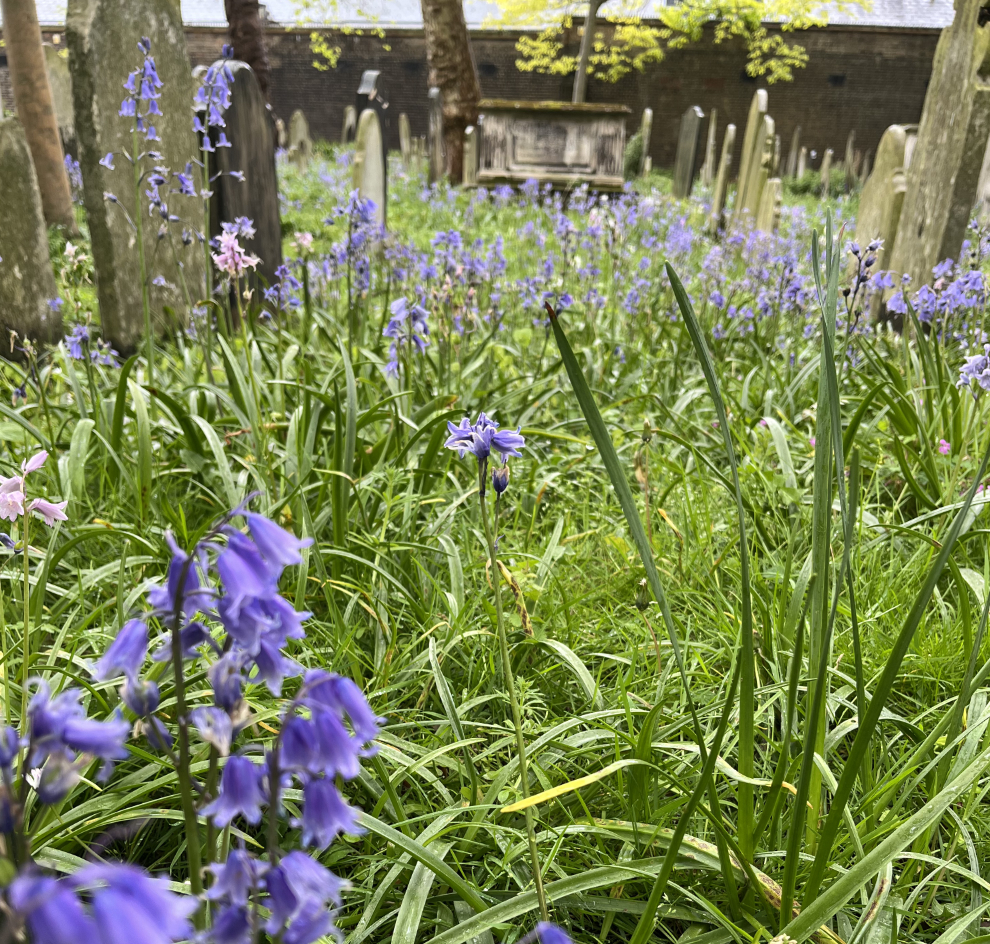
The prompt for Naporimo Day 28 is to write a Sijo poem. I’ve never written one before.
Click here for the basic details of the Sijo Poetry Form
Info resource: Nancy Jorgensen, and Writing Cooperative.
Basics
· Sijo are written in 3 lines. Each line is divided into syllable groupings.
· Line one: 3–4–4–4 (introduction)
· Line two: 3–4–4–4 (development)
· Line three: 3–5–4–3 (twist and conclusion)
· Topics are varied, from nature to historical events, to contemporary humour
· Sijo should have a musical quality
· Sijo should be emotional and resonate with readers
I don’t know if the Sijo poem should have a title, but I call mine Bluebells of Bunhill. I hope you enjoy my humble attempt at this beautiful poetry form.
Bluebells of Bunhill
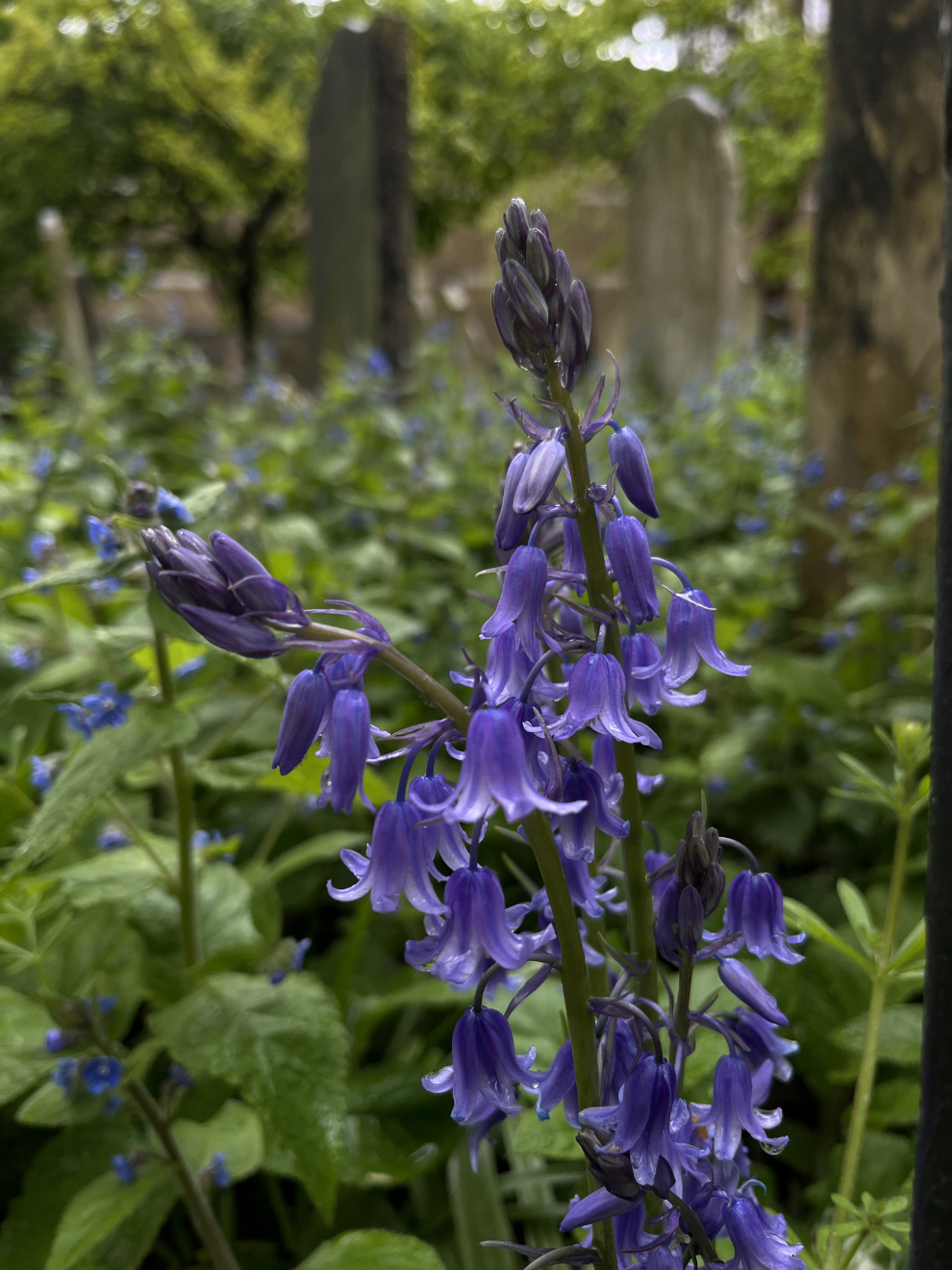
I tread where blossoms fall like snow, and bluebells ring with fragrant song.
Above, the poets lie ten deep, wrapped in that forever dream of sleep.
Their haunting histories linger still, hushed in the shade of Bunhill Fields.
Lesley Scoble, April 2024
Bunhill Fields, London
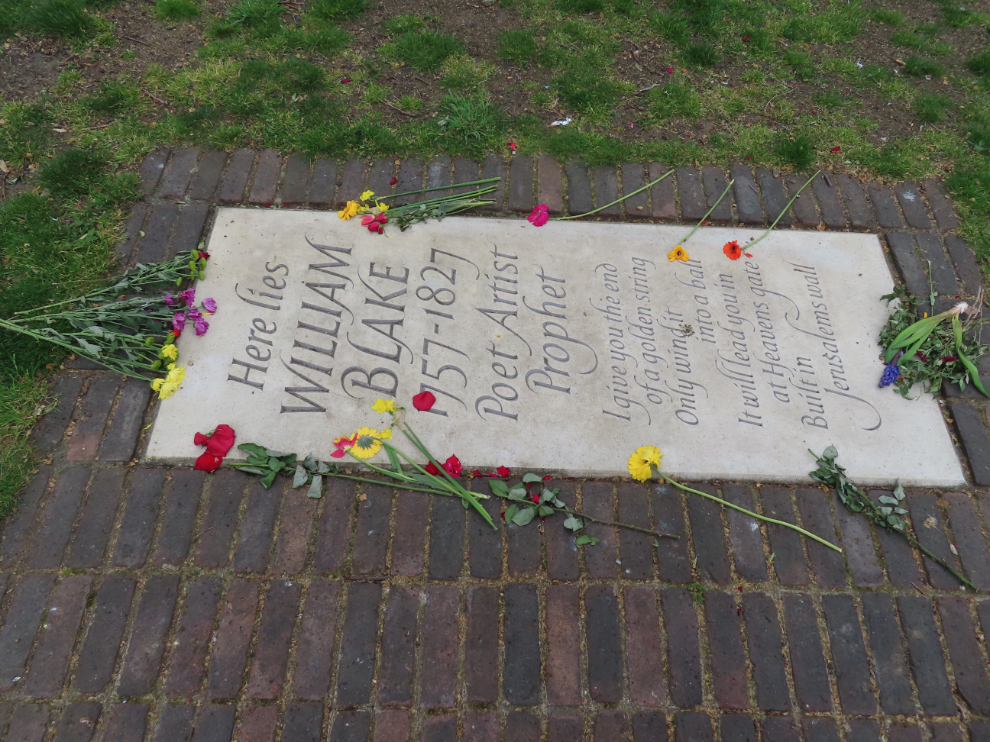
Yesterday, (28th April) I took a walk through Bunhill Fields. It was raining, and the bluebells were in bloom. The old cemetery keeps quite a mysterious atmosphere. William Blake (1727-1857) and John Bunyan (1628-1688) are just two of the writers who lie here…
Through the rain I saw the blaze of blue flowers of beautiful bluebells, alkanet and ceanothus. They inspired me to write my first attempt at a Korean Sijo poem (I suspect it may be my last as the strictures of this form are difficult!).
NOTE
In my poem, I mention “where poets lie ten deep”. One of my favourite poets, William Blake (1757-1827), lies in Bunhill Fields. There are nine more burials stacked up above his resting place.
Thank you, NaPoWriMo, for your Day 28 prompt. The prompt encouraged me to try writing a Sijo poem. I signed up to Naporimo intending to join in their write a poem a day through April challenge. I am sorry to say that I failed in the task. This is the only poem out of thirty… but hey, one is better than none, right?
Post Script
Over half of the world’s population of bluebells bloom in the UK.
If you see them growing in a thick carpet in a woodland, it is likely you are standing in a 400-year-old woodland or ancient wildwood. They are precious flowers. It is against the law to pick, uproot, or destroy bluebells. They take 5 to 7 years to establish from seed to flower.

The Spanish bluebell versus The Native bluebell
The invasion in 1588 by the Spanish Armada was not the only time the Spanish invaded our shores.
The bluebells in Bunhill Fields (sadly) appear to be of the hybrid invasive Spanish bluebell species that threaten our native species.
 The Victorians introduced the Spanish bluebells into Britain as a garden plant (which, of course, escaped into the wild).

Our Native Bluebell
Also known as common bluebells, English bluebell, British bluebells, wood bell, fairy flowers and wild hyacinth.
Flowers in April and May.
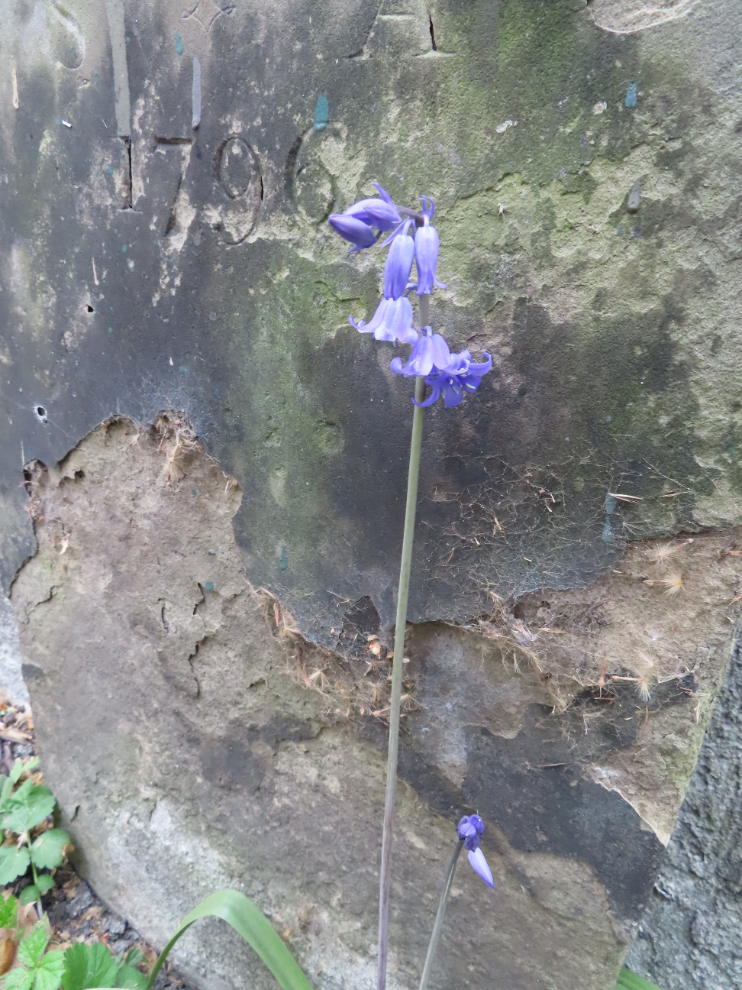
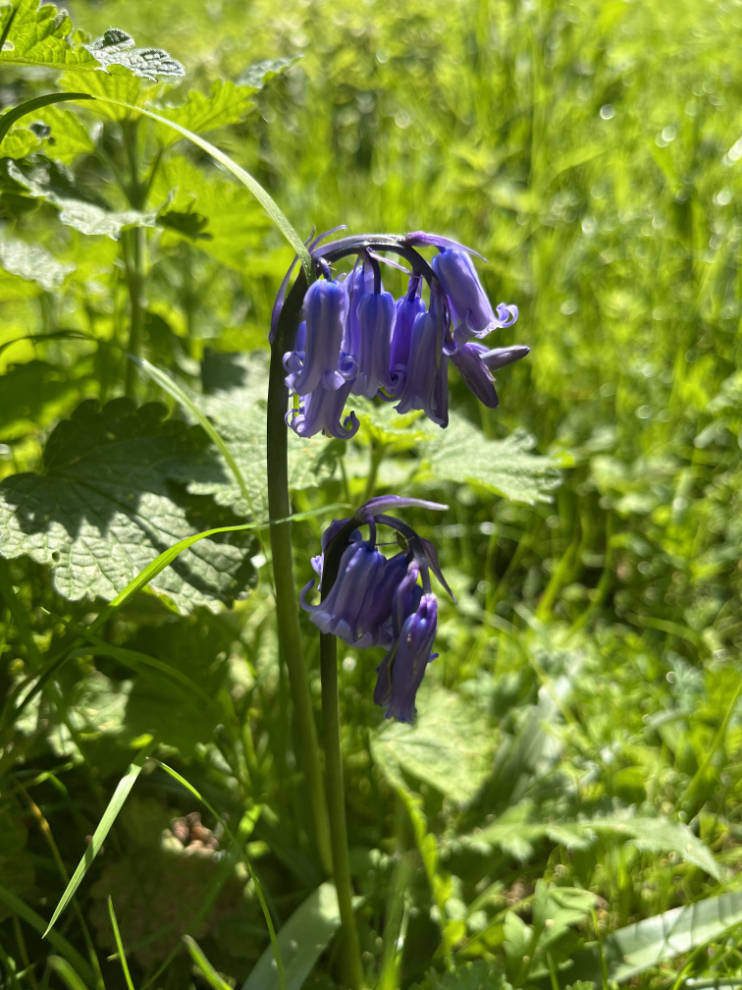
Features: Narrow leaves, the colour is a deep violet-blue (sometimes white) tubular bell flowers with tips that curl back. Distinct drooping stems and they have a sweet scent.

The Spanish Bluebell
Their stems are upright and (worst of all) the flowers have no scent.
Features: Broad leaves, the colour is pale blue (often pink or white) conical bell flowers with spreading and open tips.
~
I was ecstatic to see this native bluebell growing in our local wildlife garden.
Lesley lives in the City of London Square Mile. An artist, actor and sculptor (her first ceramic sculpture won the V&A inspired by… Award). Scenic artist & book illustrator, playwright, (her musical play, Rapscallion performed in inner city schools and theatre school); TV dancer; Animator and illustrator for TV production. Set up Pinecone Studios Ltd and IIMSI Ltd drama and filmmaking workshops in London – producing award-winning films made by children.




 LesleyScoble.com
Leave a comment