
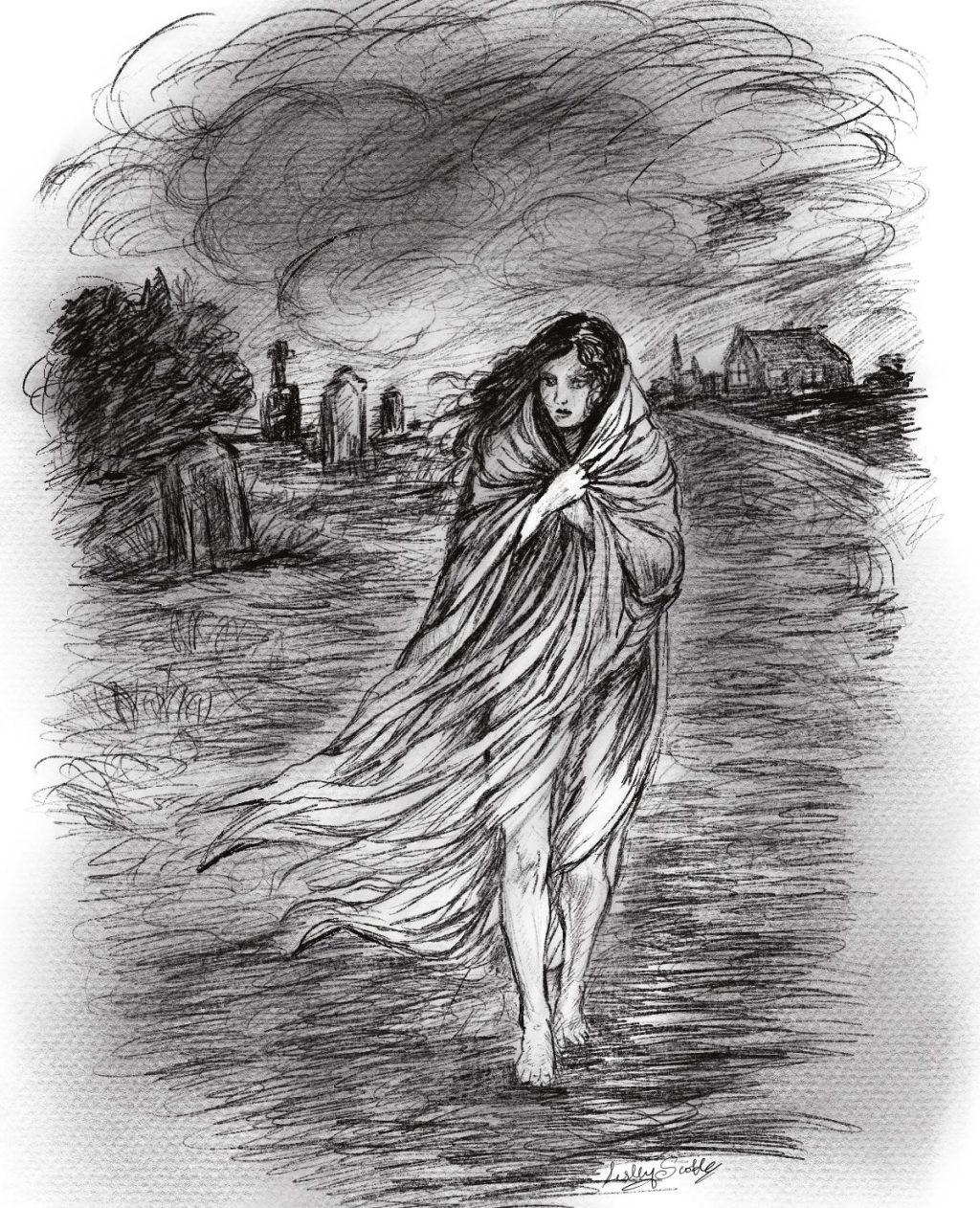
I wrote my poem Knock at the Wake to the W3 Poetry Prompt #205, where the Poet of the Week, Marion Horton, invites us to explore the theme: Beneath the Surface.
“With spring flowers pushing up along the verges, it’s easy to forget how long they lay buried in darkness as bulbs. That contrast draws my attention to what remains unseen—what lies beneath, whether in the soil or within ourselves.”
“I’m curious to see what emerges.”
“Write in any form in 20 lines or fewer.” (Oops, I think my poem overruns by 5 very short lines).
My first idea was to write about snowdrops in a silent woodland, pushing their way up through from the dark, frozen depths of winter. How I got from there to an Irish tale about a young woman lying in her grave, I can’t imagine.
Knock at the Wake
falling ill
I died from a fever
and lay in the graveyard near Shankill

they said,
fearing the sickness
bury her quick
or we’ll all be dead

I lay deep
in the ground
where no light shines,
no wind or breath

left alone,
asleep
in death

in my grave,
six feet under
in the dark,
ripe to plunder

grave robbers came and dug me up
they cut off my finger to steal my ring
I opened my eyes       they ran off screaming

for pity’s sake

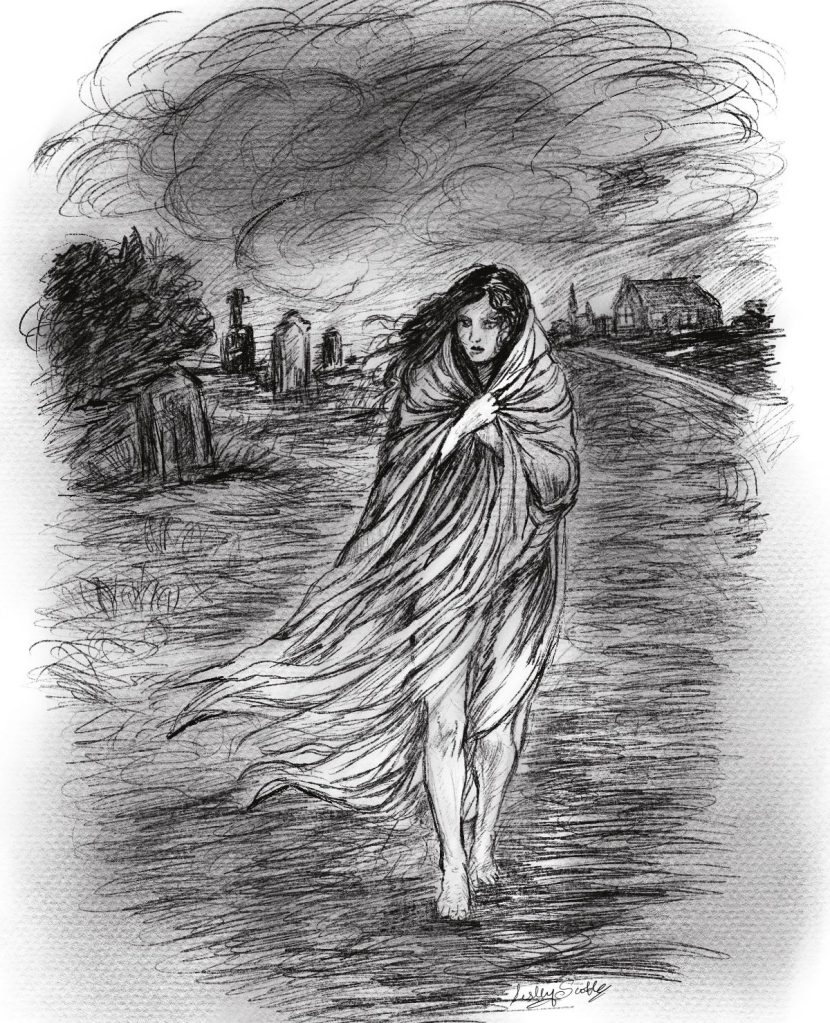
I went home in my shroud
knocked on my door
and joined my wake


—Lesley Scoble, March 2026
A little bit of history
My mother was Northern Irish, and her childhood home was in Lurgan, County Armagh. I remember many happy holidays visiting relatives there. In the centre of town, in a bar called the Brownlow Arms, a large black kettle hung on a crook over the fire to heat the water for whiskey. I quaffed a few jars and listened to many a yarn with my wild Irish cousins by that hearth.

One such tale tells of a young woman, Marjorie McCall, who died of a fever in the 1700s and was buried in haste to prevent contagion. Before modern medicine could reliably confirm death, premature burials were not unheard of. On the night of her interment, while her family mourned at the wake, grave robbers dug her up. The family had been unable to remove a valuable ring from her finger and so buried it with her. According to the story, the robbers’ attempt to cut the ring free jolted her back to life, resurrected (so to speak) by body snatchers intent on stealing her valuables and selling her corpse.

In the 18th and 19th centuries, grave robbing was common because medical schools needed bodies for anatomy lessons.

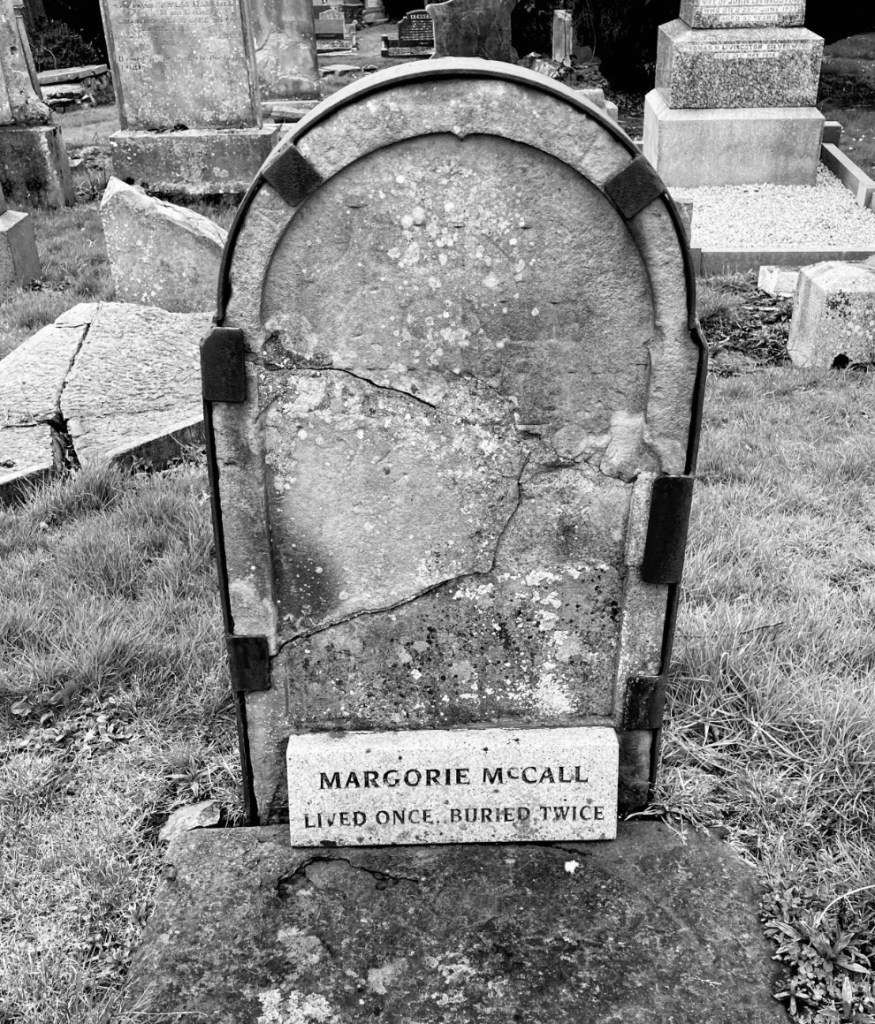
I visited her grave and felt oddly disappointed. There was a simple cold stone saying that she “Lived once, buried twice.” No drama, no gothic eeriness. It was just a plain memorial in the Shankill graveyard stating a fact.

A young woman had been buried and later that night exhumed by body snatchers intending to steal her valuables and sell her corpse. The thieves fled in terror when she regained consciousness (and who wouldn’t‽ ).

Marjorie clasped her shroud around her shoulders, walked home (no doubt with some difficulty in her weakened state), and knocked on her own front door. The tale suggests that her husband fainted, believing her to be a ghost (hardly surprising). They went on to raise several children until the time came for her real death.

I looked at the simple grave and thought what if those grave robbers hadn’t dug her up…

Because of such fears, inventors created devices called safety coffins. These might include a bell attached to a string to the person’s finger, or a flag or signal pole above ground (might be mistaken for the wind), even breathing tubes could be provided. If the buried person revived, they could ring the bell to alert the graveyard watchman and be, quite literally, saved by the bell.
Marjorie McCall’s Grave — Lived Once, Buried Twice
ACKNOWLEDGEMENTS
My thanks to Marion Horton for inspiring my poem with her Beneath the Surface prompt.
My thanks as always to the maestro, David, The Skeptics Kaddish for his amazing poetic encouragement.
And my gratitude to you, the reader, for spending time with me.



 LesleyScoble.com
Leave a comment