


The Unicorn Challenge
The Unicorn Challenge invites us to write something inspired by this photo in 250 words or less.
My story Marston Moor is an exact 250 words.
The prompt also inspired me to paint the digital watercolour of James, the protagonist in my story.
The photograph for the Unicorn Writing Challenge made me think of a visit to the Yorkshire moor, one mile from Tadcaster. To the battlefield of Marston Moor.
When I stood on the very ground the battle was fought upon, the earth of the moor itself still bleeds the story. I was struck by the mood of the place.
Musket-balls still turn up in the soil today.
Marston Moor

MARSTON MOOR

His eyes strained east, looking for them. He could see nothing, but they were there. He could smell them. He could smell the campfires from their nearby encampment and taste the imagined broth from the stewed aroma that wafted on the air across to him on the breeze.
The Royalists were in acrimonious disorder. Some troops had only just arrived at the field and were preparing their evening meal.

The sun shone for a moment, appearing through the light rain, with a dismal reluctance that matched his own.

James wondered how much longer they were to wait. He held on to the hilt of his sword for assurance. He was ready.

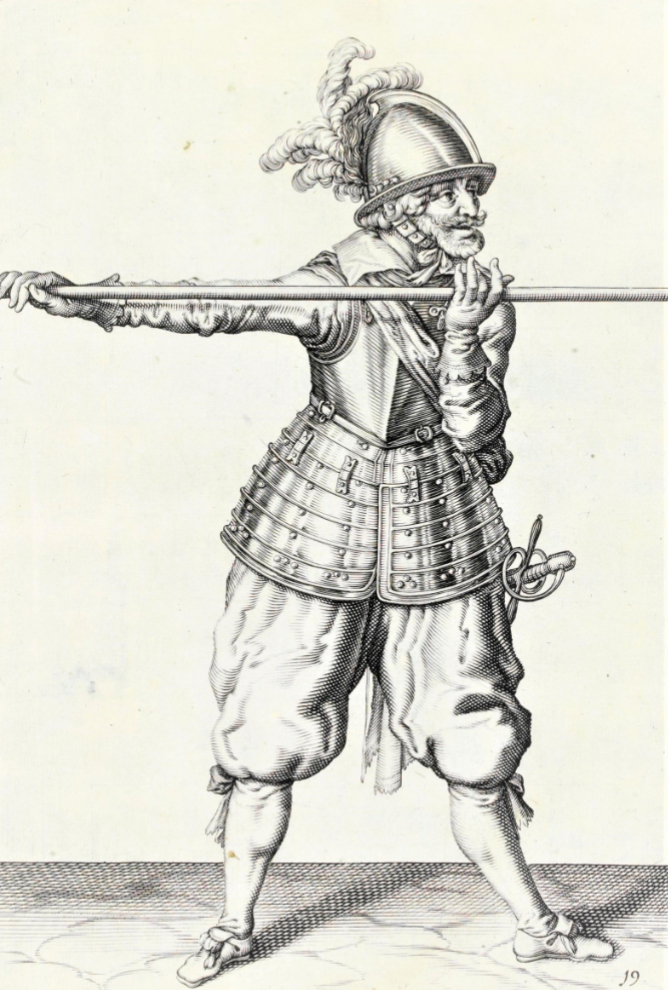
To the front, their pikemen were prepared and presented a formidable line. The tall wooden pikes formed a vast, intimidating fence. He glanced to his side where the Yorkshire foot stood alongside his own Scottish Covenanters. He looked along the line where his fellow countrymen waited. They were here for the cause and to support their covenant. They wanted rid of the catholic king, too.

The white plume in his blue beret fluttered in a wave. His gaze crossed the moor, which reminded him a little of his lowland home. The grasses waved back at the plume in his cap.

At about 7 O’clock in the evening, two of Cromwell’s guns fired upon musketeers, who were in a position that threatened his plan of attack.

For the hungry Royalists who hadn’t eaten since dawn, it meant dinner was cancelled.


Lesley Scoble, October 2023

A little bit of history
NOTES

MARSTON MOOR
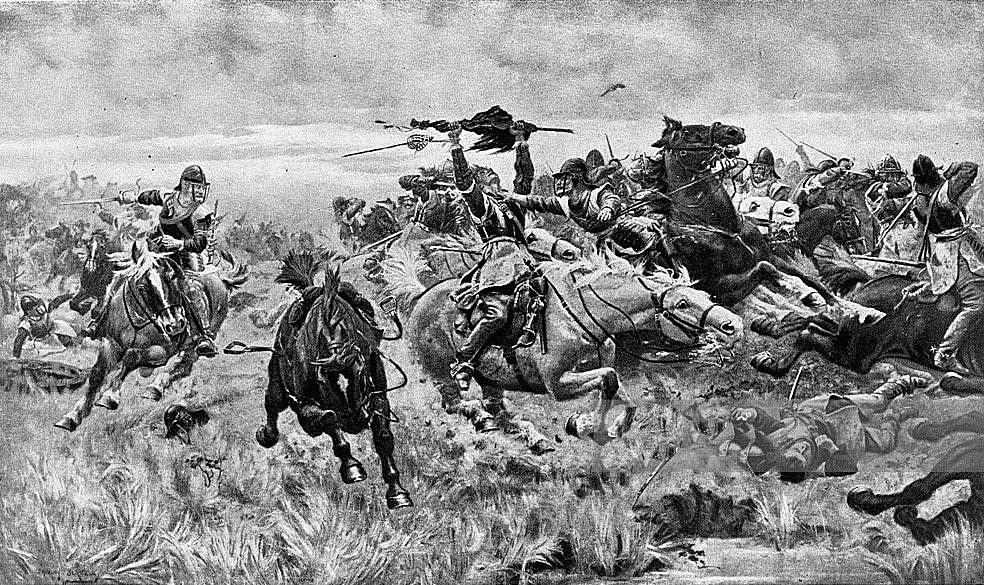
Marston Moor, July the 2nd, 1644, was a famous deciding battle in the First English Civil War (1642-46). It proved the military prowess of Cromwell.

This was the largest battle in history to be fought on English soil. The battle involved over 45,000 men. The Royalists lost the fight despite outnumbering the Parliamentarians and their Scottish allies.
4,000 Royalist dead and 1500 captured.
Cromwell lost 300 men.

James
The Scottish Covenanter in my story is Sergeant Major General of Foot, James Lumsden, who played a significant part in the Parliamentarian success of the battle.

MILITARY UNIFORMS
Soldiers did not wear a formal uniform during this period.
Both sides would have worn similar clothing in the day's fashion.
It was wise to wear a recognisable token to identify which side you were fighting for and vital to wear an ID.
It is a likely possibility that James was wearing the blue beret with a white plume, which was a popular insignia of the Scottish Covenanters.

THE NEW MODEL ARMY
There was no official army until the New Model Army in 1645, created by the Parliamentarians during the First English Civil War. (The Stuarts disbanded it in the Restoration in 1660).

THE SECOND ENGLISH CIVIL WAR
The Second English Civil was a bout of rebellions in England and Wales between February and August 1648.
It is grouped among several conflicts to fall under the banner of the War of the Three Kingdoms (1641-1653).
The Irish Confederate Wars (1639-1640) (the Irish still hate Cromwell)
The Bishops War & The Belligerents (1649-1653)
(Sometimes, when I was a child, I’d be told to not be belligerent. I never realised the true meaning of this till recently!)
The Belligerents were the English and Scottish Royalists versus the Scottish Covenanters’ combatants in the Bishops’ War.
Cromwellian Conquest of Ireland
Then, there was the Cromwellian Conquest of Ireland (Cromwell didn’t gain any fans in Ireland for this action, either).

ACKNOWLEDGEMENT
My thanks to the incredible Cromwell Museum. I enjoyed a visit to this museum in Huntington in the schoolhouse where Cromwell went to school.
Source The Cromwell Museum, Huntington
My thanks also, to Prisoners of Eternity

Last but not least, my thanks to Jeanne and C. E. Ayr, The Unicorn Challenge for the inspiration.
“Cromwell’s own division had a hard pull of it, for they were charged by Rupert’s bravest men both in front and flank, they stood at their swords point a pretty while, hacking (at) one another but at last (it so pleased God) he broke through them, scattering them before him like a little dust.”
Lesley lives in the City of London Square Mile. An artist, actor and sculptor (her first ceramic sculpture won the V&A inspired by… Award). Scenic artist & book illustrator, playwright, (her musical play, Rapscallion performed in inner city schools and theatre school); TV dancer; Animator and illustrator for TV production. Set up Pinecone Studios Ltd and IIMSI Ltd drama and filmmaking workshops in London – producing award-winning films made by children.


 LesleyScoble.com
Leave a reply to Nicole Smith Cancel reply