Once upon a time,
In Britain,
There lived a common bird
Called the crane,
So common,
At banquets
And feasts
They served crane as the main—
Washed down with wine…
Then they ate them again,
They ate them right down to the line,
They ate them all,
They ate them all.

Gone was their call,
Gone was their flight,
None were seen in the day,
None in the night,
None in sight,
None at all,
None at all,

Once upon a time,
In Britain,
There were wetlands,
and marshy terrain,
But
They drained them,
Drained them all.

In the UK,
For 400 years
The crane was unseen,
Unseen
Since 1465
None seen alive,
Until 1979,
When three migrant cranes,
In thunder and rain,
Blew off course,
Arriving like folkloric ghost planes—
Airships from the past,
They flew in on the wind—
And landed in Norfolk,
Ok
At last,
At last.

They thrived in Norfolk’s wild land,
And once more,
In Britain,
Cranes
Are seen again,
Seen again.

The crane loves to dance,
Sing and beguile,
With rhythmic elegance,
Fine gestures
And style,
They bob
And bow,
Crane their beautiful neck,
And dance in duets,
Safe from archbishops’
Banquets
And overweight kings,
Swirl pirouettes
And ballet their wings,
Both husband and wife.
Bond for life,
Bond for life.

At their fabulous spring ball,
They bugle their call,
Despite it all,
Despite it all.


Lesley Scoble, October 2024
Crane duet call (24 secs)
The Wildlife Trusts
The common crane
“The dance of the cranes is famous worldwide. Heads thrown back, wings flapping, tail feathers fluffed, and feet stamping; this is how they reinforce their pair bonds. Cranes were once so common in Britain that 204 were served roasted at a banquet for the Archbishop of York in 1465. Hunting along with the draining of marshlands led to their disappearance as a breeding bird about 400 years ago, until a trio of migrating birds were blown off course in 1979, ending up in Norfolk. Careful protection, reintroduction projects, and some landscape-scale habitat restoration projects mean that there are now around 160 cranes in Britain.”
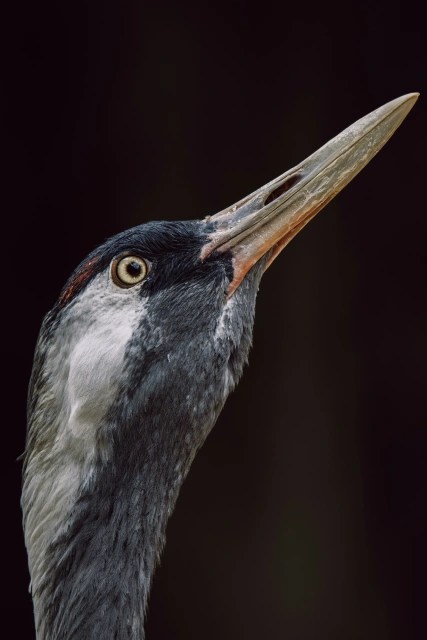
ACKNOWLEDGEMENTS Resource: The Wildlife Trusts. Please visit the Wildlife Trusts to learn more about wildlife conservation. Crane duet audio: Jarek Matusiak, Xeno Canto Thank you Melissa Lemay, for your #FFFC inspirational prompt. Prompt photo of the Crane is from Huang Qijun on Unsplash. Thank you, dear reader, for reading my poem.
Lesley lives in the City of London Square Mile. She is an accomplished artist, actor, and sculptor (her first ceramic sculpture winning the V&A Inspired by…Award). Lesley is also a scenic artist, book illustrator, playwright, TV dancer, mime artist. Animator & illustrator for TV. She founded Pinecone Studios Ltd and IIMSI Ltd, producing award-winning films made by children drama and filmmaking workshops in London.
This would be great read aloud! So, are cranes still eaten in the UK? Roast crane.🤮 I’ve been searching pictures of anhingas (which I’d never heard of before the other day) and cranes since yesterday now.🤣 Someone ought to write Huang and let him know.
There are still only about 250 crane in the UK. I certainly hope they don’t get eaten! Thanks for your comment about reading it aloud, Trip. A friend made a suggestion about singing it! Can you sing?
Lesley. Ha conmovido a mi pensamiento tu poema, y afianza mi armonía ante la vida la danza de las grullas, recordé imágenes leídas en “El ritmo infinito” de Michael Spitzer, acerca de la banda sonora de nuestras vidas, algunos sonidos del saxo imitan a las grullas y transmiten los sentimientos que devela el jazz y las bandas de tu tierra, con razón hay cierto equilibrio en la armonía de la vida con el regreso de las grullas como tu poema,.
Muchas gracias por su maravilloso comentario de elogio. Estoy muy conmovida. No he leído “El ritmo infinito” de Michael Spitzer. ¡Voy a pedir una copia! Gracias de nuevo, Guillegalo, tus palabras significan mucho para mí. 🙏🩷




 LesleyScoble.com
Leave a reply to lesleyscoble Cancel reply