
I wrote Bath-Time Apocalypse in response to Melissa’s Fandango Flash Fiction Challenge #332, which invited writers to spin a tale inspired by the evocative photo below—captured by Vitaly Mazur on Unsplash.

My surreal poem is accompanied by its musical counterpart at the end of the piece. I hope you enjoy both the verse and the rhythm it inspired.
Bath-Time Apocalypse
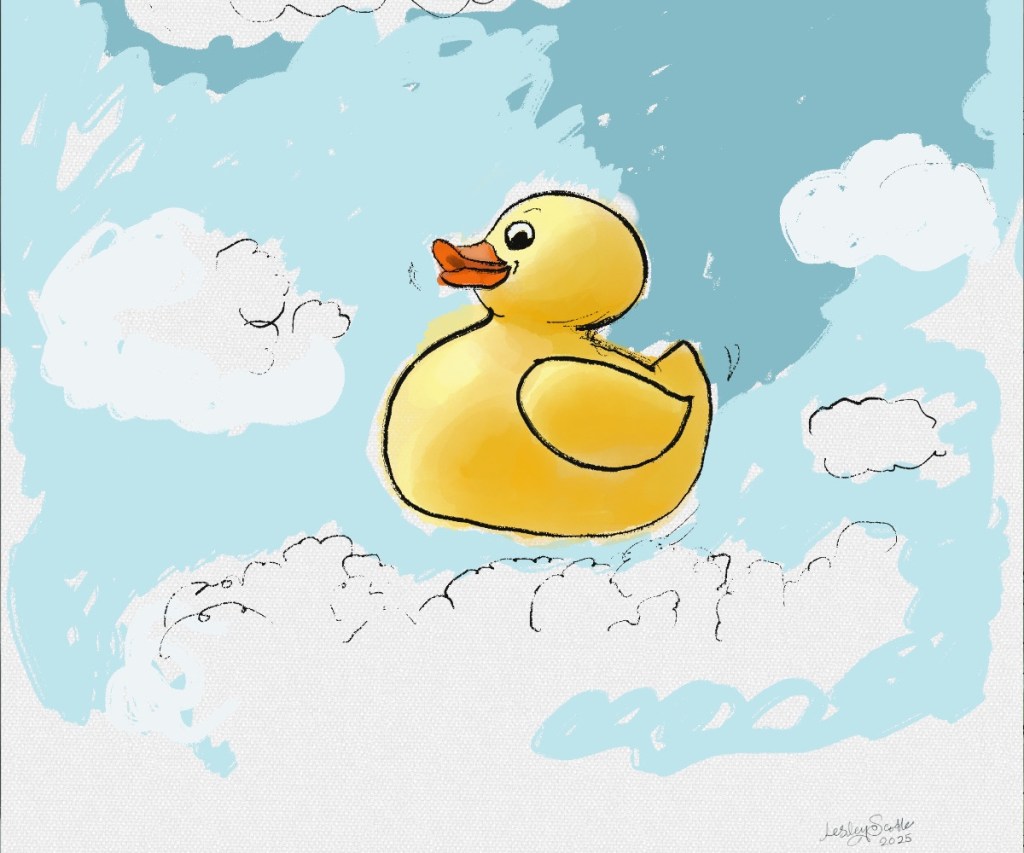
There were rubber ducks everywhere—
they were floating on the sea,
and floating in the air—
hundreds and hundreds
in a great multiplicity.
Why were they there?

I couldn’t believe what I saw:
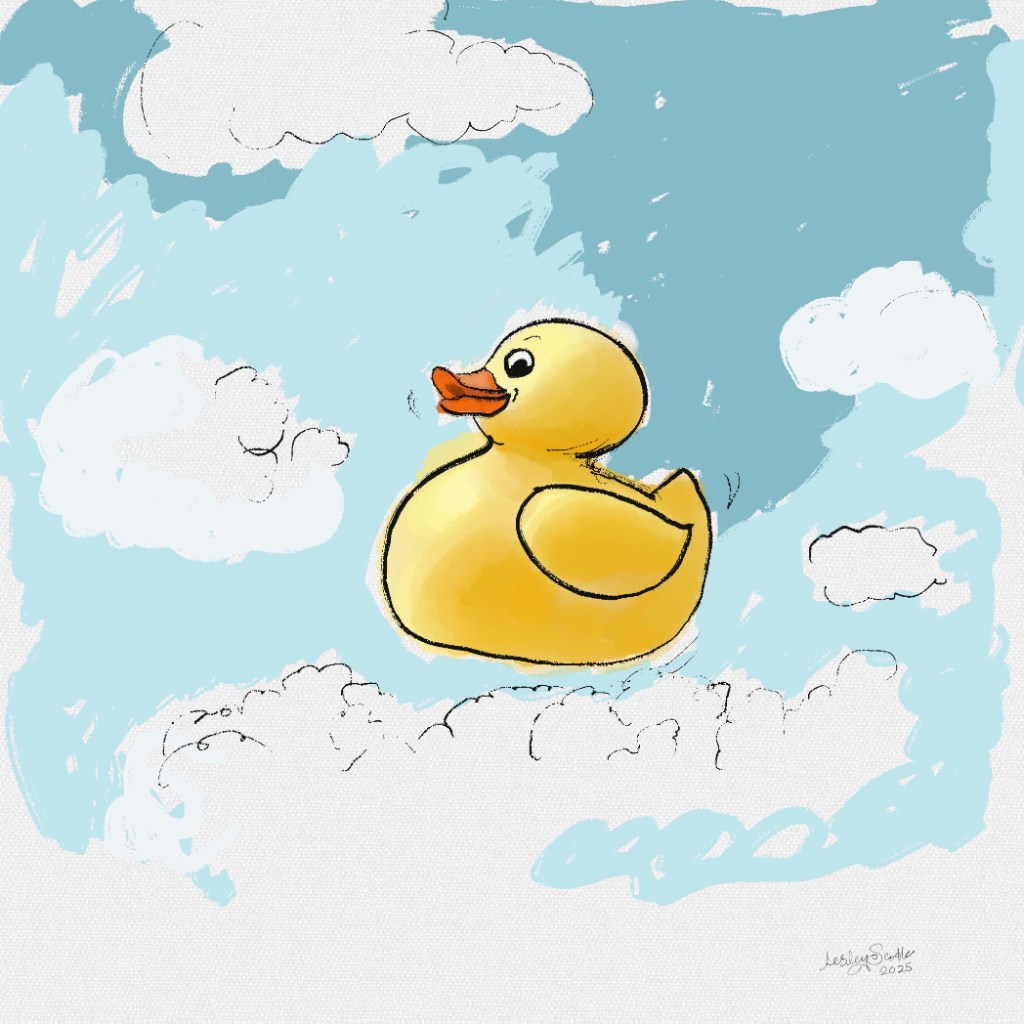
I saw a huge one in the sky,
and a crowd below,
mouths ajar,
gazed up at it in awe.
What a massively huge, and bright rubber duck—
I gasped and said, “What the f…
fantastic piece of luck!
To see such a sight.”

I’ve never seen one quite so big,
nor one quite so yellow.

“Do you know where they’ve come from?”
asked a man in a hat.
“No, my good fellow—
I can’t answer that.
I haven’t a clue.”

”Have you?”

I looked up at the duck and started to laugh—
Can you imagine the size of the bath‽


—Lesley Scoble, August 2025
🎵 Bath-Time Apocalypse: The Song
I’m thrilled to unveil the musical incarnation of the poem—where rubber ducks riot and bubbles burst into rhythm. Dive in and enjoy the sonic splash!
A Fascinating Piece of Info about Rubber Ducks
🦆 The Great Rubber Duck Spill of 1992
In January 1992, a container ship named Ever Laurel was caught in a storm in the North Pacific. Among the cargo lost overboard were 28,800 plastic bath toys—a mix of yellow ducks, blue turtles, green frogs, and red beavers. These toys, later dubbed the Friendly Floatees, were sealed and watertight, making them unusually buoyant and remarkably durable.
🌍 Global Journey & Scientific Impact
The toys floated across oceans for more than 15 years, washing up on shores from Alaska to Hawaii, Japan to Newfoundland—and eventually, Britain and Ireland.
Oceanographer Curtis Ebbesmeyer tracked their movements, using the ducks to study ocean currents, plastic pollution, and even climate models.
Some floated over the site of the Titanic, while others became frozen in Arctic ice before drifting into the Atlantic.
🇬🇧 Arrival on British Shores
Ebbesmeyer predicted that the ducks would reach South West England—especially Cornwall—due to prevailing Atlantic currents. Sure enough, the ducks arrived, bobbing along British coastlines.
THANK YOU
Enormous thanks to Melissa Lemay for her inspirational prompts.
My heartfelt thanks to you, the reader, for reading and listening to my poem.





 LesleyScoble.com
Leave a reply to lesleyscoble Cancel reply