
The Black Cap is my first Versiprose (or Prosiverse or Prosimetrum) written in response to poet-of-the-week Reena Saxena’s evocative prompt. Crafted for W3 Prompt #180, it draws inspiration from the two featured photographs. Click below to read the full prompt and poetry form guidelines.
Click here to read Reena’s poetry guidelines
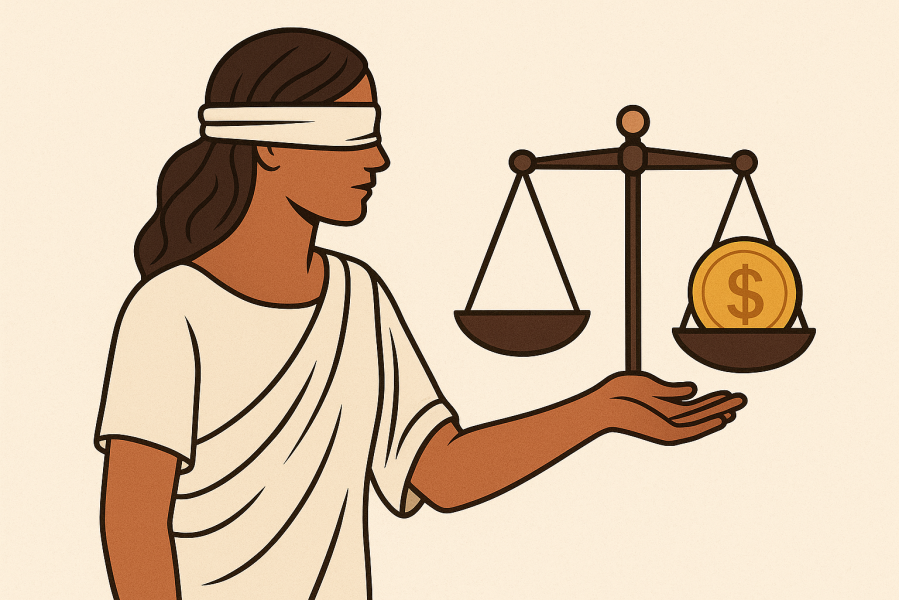
This week, we explore the interplay between prose and poetry. Use one or both of these images as your inspiration — a blindfolded Lady Justice whose scales are tipped by money or a crumbling courthouse.
Write in either Prosimetrum or Versiprose form: both combine alternating passages of prose and verse.
- If the prose dominates, it’s Prosimetrum.
- If the poetry dominates, it’s Versiprose.
Find details on the format here.
For an additional challenge, ensure that your poem includes at least three and no more than twelve lines of verse. Prose sections may be any length. The poetry may be free verse or syllabic, or a mix of both.
For reference, here’s an excerpt from La Vita Nuova by Dante (translated):
Prose:
After my birth, the star of Venus had twice returned to the same point… She appeared dressed in subdued crimson, modest and dignified.
Verse:
Love and the gentle heart are one and same
As the wise man in his verse has said,
And each without the other finds no home,
Just as the soul within the body’s frame.

I hope you enjoy my first *Versiprose or Prosiverse or prosimetrum!
The Black Cap

The judge sat with his dreaded black cap upon his head—and looked down at the pathetic figure upon whom he was about to pass sentence. The courtroom held its breath.

His hands were cuffed.
His head was bowed.
He stood in the dock,
beaten and cowed.

“I’m innocent m’Lud.
I didn’t do it.
I loved my wife with all my heart.
I’d never push her off a cart.”

The judge said,
“If you didn’t—then who did?”
“It wasn’t me!” said Fred,
“It was my mate Sid.”

All eyes turned in the courtroom to the public gallery. A little man sat hunched in the third row. Sid shifted uncomfortably in his seat. “It wasn’t I,” he said. “I’d never want his missus to die.” Sid’s shifty eyes pleaded innocence unconvincingly.


—Lesley Scoble, October 2025
Music Audio – The Black Cap
Alternate ending to The Black Cap poem
The rules of Reena’s prompt were to write no more than 12 lines of verse.
The ending of my poem is deliberately inconclusive.
But if you’d prefer a definite conclusion, you’ll find an illegal extra four lines for an alternative ending tucked in my secret drawer below.
Secret Drawer
Final verse
But it was too late for Fred,
by heck! In the morning
he was hanged by the neck
until he was dead.
—Lesley Scoble, October 2025
Notes
Origins of the Black Cap Tradition

Introduced in Tudor times, the black cap was part of formal judicial dress. It was a square piece of black silk placed atop the judge’s wig, with one corner facing forward.

The cap symbolised solemnity and mourning, worn when passing the sentence of death—typically for crimes like murder or treason.

The phrase often accompanying the sentence was:
“And may the Lord have mercy upon your soul.”


Use and Decline

Until 1957, the death penalty was mandatory for murder. Judges routinely wore the black cap when delivering the sentence.

The Homicide Act of 1957 narrowed capital punishment to specific types of murder, but judges still wore the cap when applicable.

In England and Wales, the last executions occurred in 1964, and the death penalty was abolished in 1969 for murder. This marked the end of the black cap’s functional use.

In Northern Ireland, the death penalty remained until 1973, and judges continued using the black cap until then.

In the Republic of Ireland, the tradition persisted into the 1970s and 1980s, though some judges opted not to wear it.
Postscript
Since writing what I thought was a Versiprose
I was informed by my learned friend (Muri knows all the forms) that it is, in fact, a Prosimetrum.
But after a little research, I’ve decided to settle on Prosiverse—a hybrid, contemporary form of Prosimetrum.

Prosiverse is a modern hybrid where verse dominates, but prose is used for transitions, context, or dramatic effect. The prose may be cinematic, conversational, or atmospheric—supporting the rhythm and emotional arc of the verse. Often playful, dramatic, or experimental.

True classical Prosimetrum is rooted in ancient and medieval literature—think Boethius’s Consolation of Philosophy or Dante’s Vita Nuova (as Reena’s prompt guidelines rightly point out).
In those works, prose carries philosophical or narrative exposition, while verse delivers emotional or lyrical intensity. Traditionally, the tone is formal, reflective, even didactic.
(Resource: Copilot)

Well, now we know.
I learn something new every day.
THANK YOU
Thank you, Reena, for your amazing prompt — I’ve truly enjoyed the challenge of writing my first attempt at the Versiprose / Prosimetrum / Prosiverse!
Thank you, David of The Skeptic’s Kaddish, for your constant encouragement and inspiration.
And thank you, dear reader, for spending time with my poems. 🙏
This may be my last poem for a while — I’ve been fortunate to receive some exciting art commissions that will take up most of my time—but I will still try to fit in some poetry whenever I can.
Take care, my friends,
Much love,
Lesley 🌹
To find out more about the W3 Poetry Prompts follow the link below.


 LesleyScoble.com
Leave a reply to artiecamenzind Cancel reply