
The W3 Poetry Prompt
Shaun Tenzenmen is the splendid Poet of the Week for this week’s W3 Prompt #197. His prompt is for us to write an erasure poem.
Erasure Poem
Erasure poetry, also known as blackout poetry, is a form of found poetry wherein a poet takes an existing text and erases, blacks out, or otherwise obscures a large portion of the text, creating a wholly new work from what remains. The keyword is Redacted.
I’ve never tried an erasure or blackout poem before—although I’ve certainly rubbed out my fair share of poems. The real challenge was choosing the source text. After staring at my bookcase for far too long, I finally opened an old book at random and let chance decide. The result became The E____ of R________h.
The process was unexpectedly absorbing; it forced me to study the pages of that old book with new attention. And now I’ve stumbled upon a passage recounting the 1708 French invasion attempt, which surely deserves its own erasure poem. But that will have to wait—finishing The E___ of R______h has taken quite enough time for now.
My Old Book
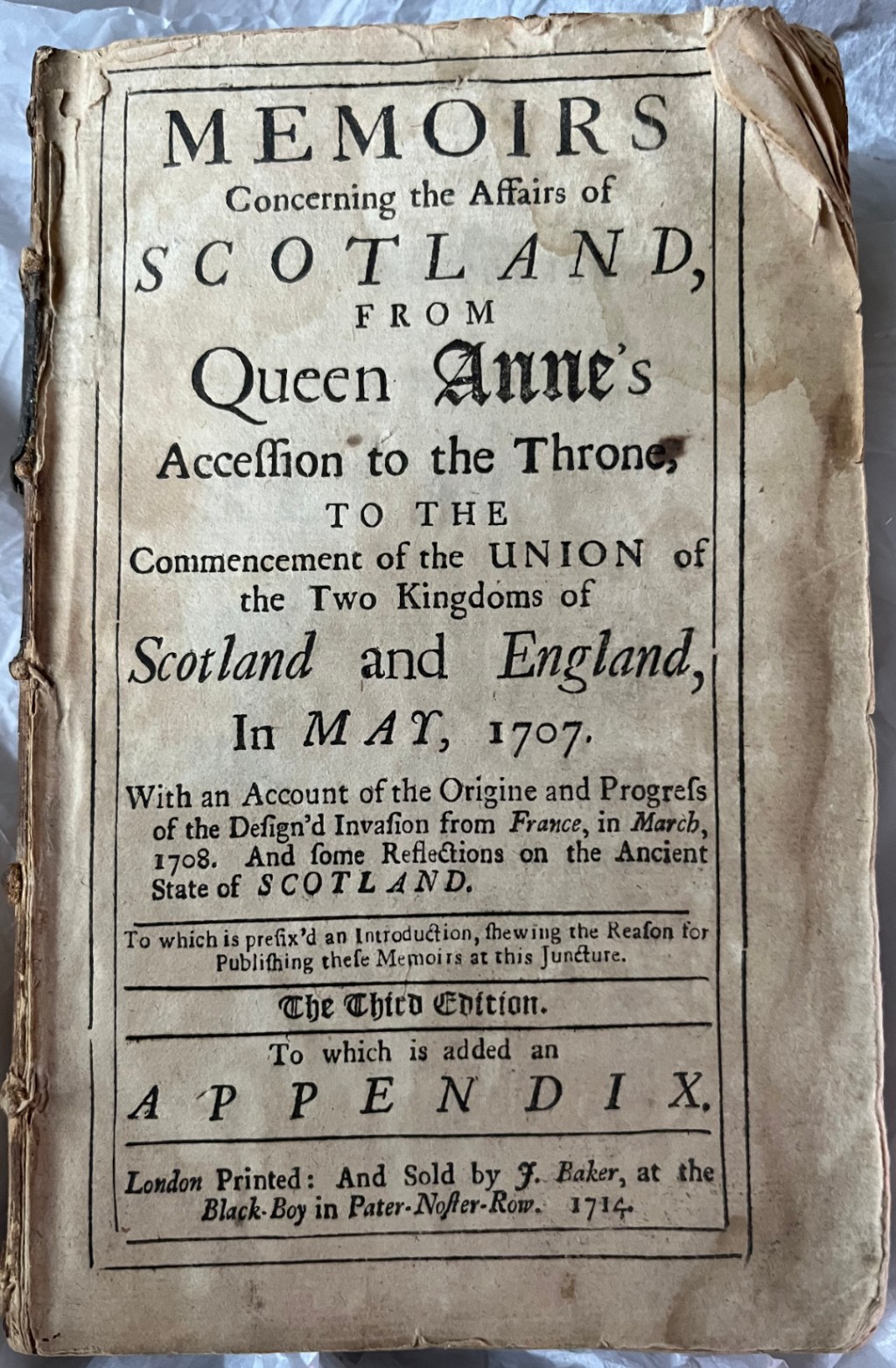
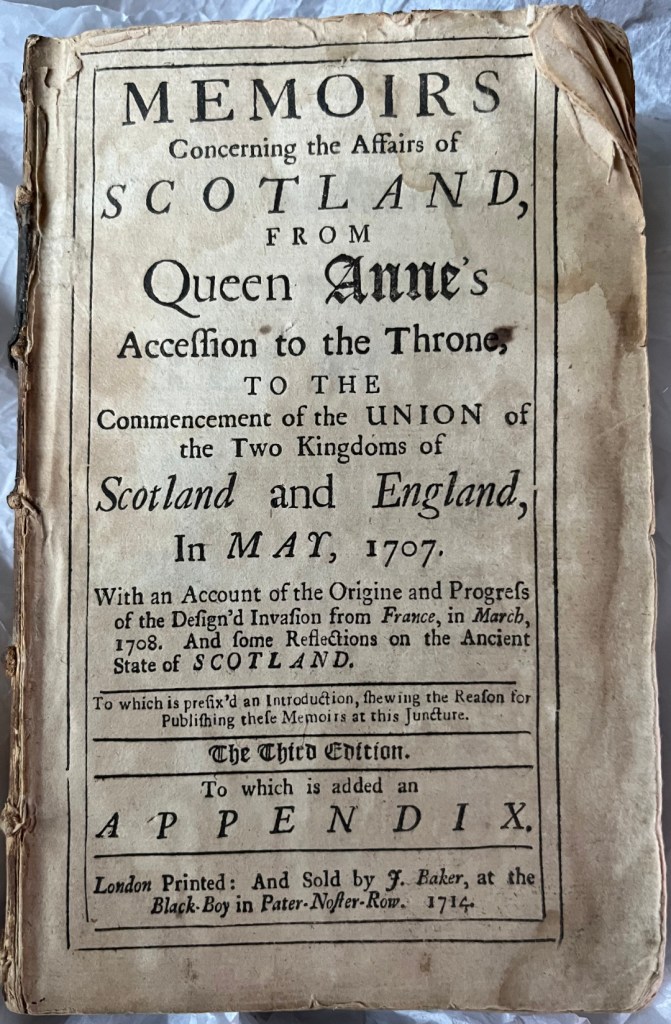
The Memoirs Concerning the Affairs of Scotland is an early 18th‑century work, published just seven years after the 1707 Act of Union. It is part history, part political commentary, part insider account. It is a rare book, and I’ll tell you how I came to own it at the end of this post.
Its publication in 1714 was controversial, and the author remained anonymous, though scholars generally attribute it to George Lockhart of Carnwath (1673–1731)—a prominent Scottish Jacobite, MP for Lanarkshire, and one of the few Scottish commissioners who opposed the Union.
It was printed just down the road from where I live, in Paternoster Row, which was at the heart of early‑18th‑century book printing. There is also a Key to the book, printed in Cornhill and sold for six pence. The Key reveals all the redacted names of the Jacobites. The title for my poem is E____ of R_______h, as it appears in the Memoirs. In the Key, he is identified as the Earl of Roxburgh.
The book emerged in the midst of a turbulent political period. The memoir covers the negotiations, tensions, and manoeuvring that led to the unification of Scotland and England into Great Britain.
The end of Queen Anne’s reign (1702–1714) was marked by fierce debate over Scotland’s future, the War of the Spanish Succession, Jacobite plotting, and the eventual Union of the Parliaments. It felt like the perfect text to use for my erasure poem.
The E____ of R________h
An Erasure Poem from the Memoirs Concerning the Affairs of Scotland
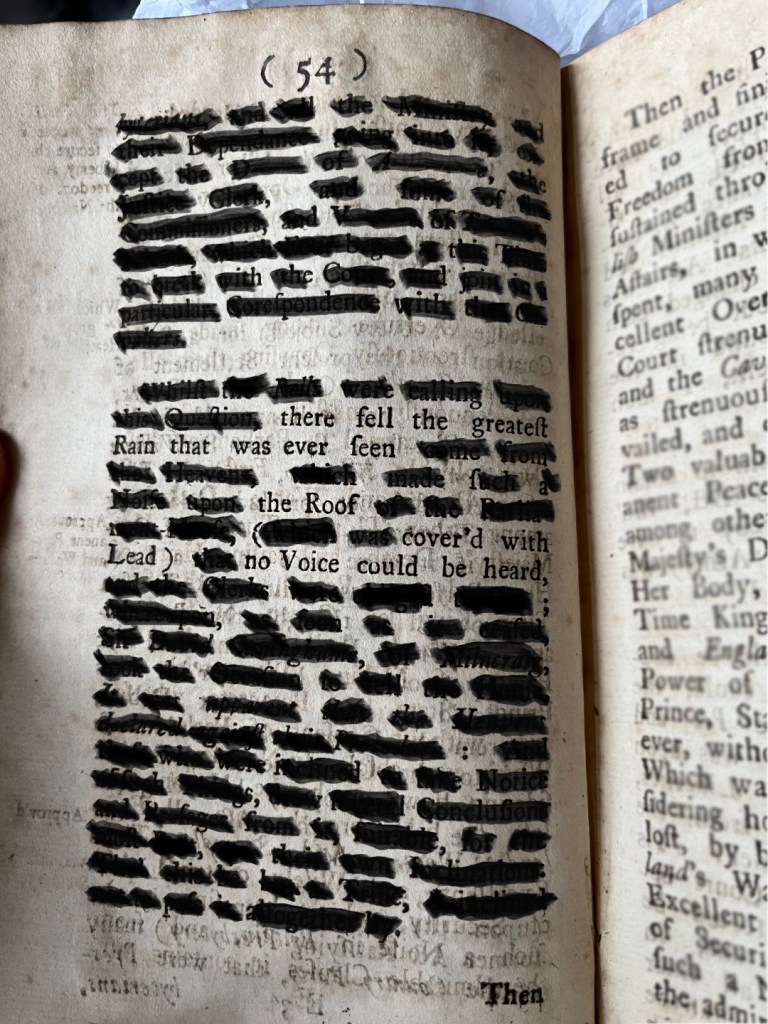
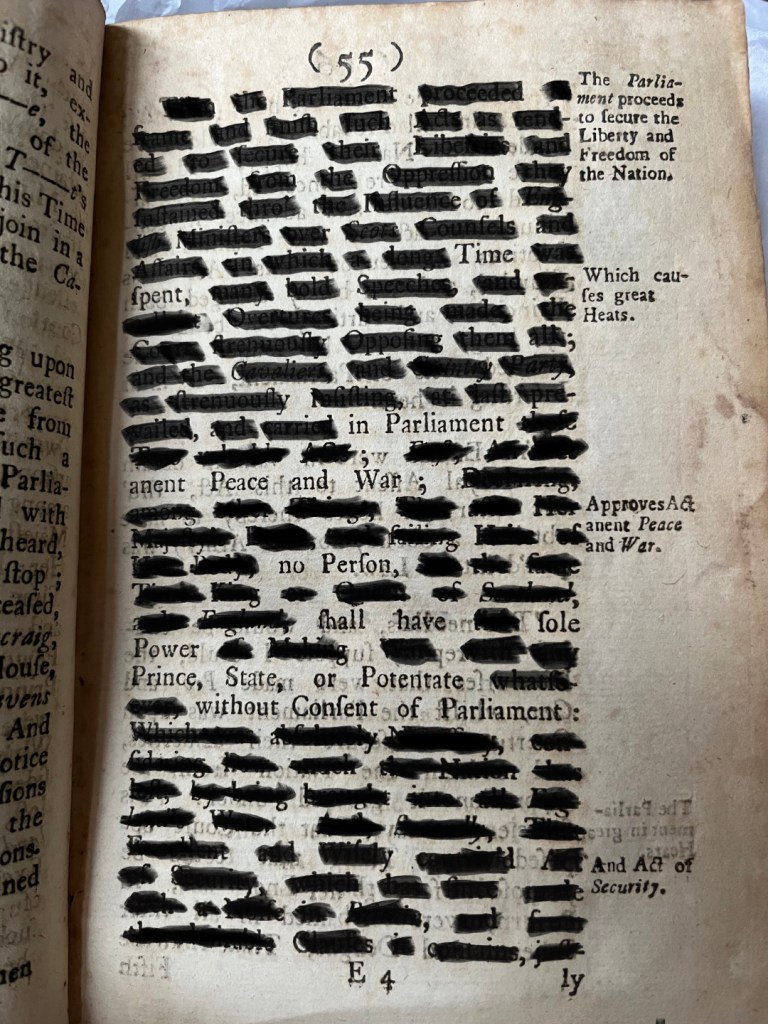
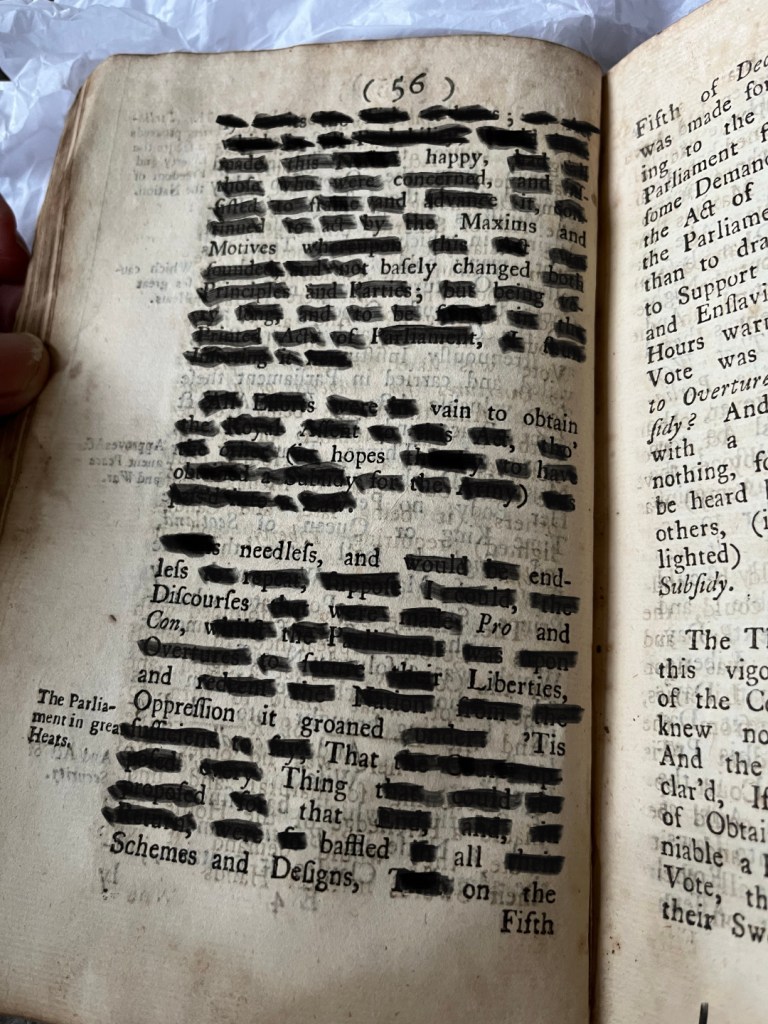
there fell the greatest Rain
ever seen
the Roof
covered with lead—
no Voice
could be heard

Time spent
in Parliament
anent
Peace and War
no Person
shall have
sole
Power—

Prince, State,
or Potentate
without Consent
of Parliament

happy
Maxims and Motives
basely changed
hopes
needless and endless
discourses

Pro and con
upon
Liberties
and
Oppression
it groaned

‘Tis that thing—
that baffled all
Schemes and Designs
on the Fifth

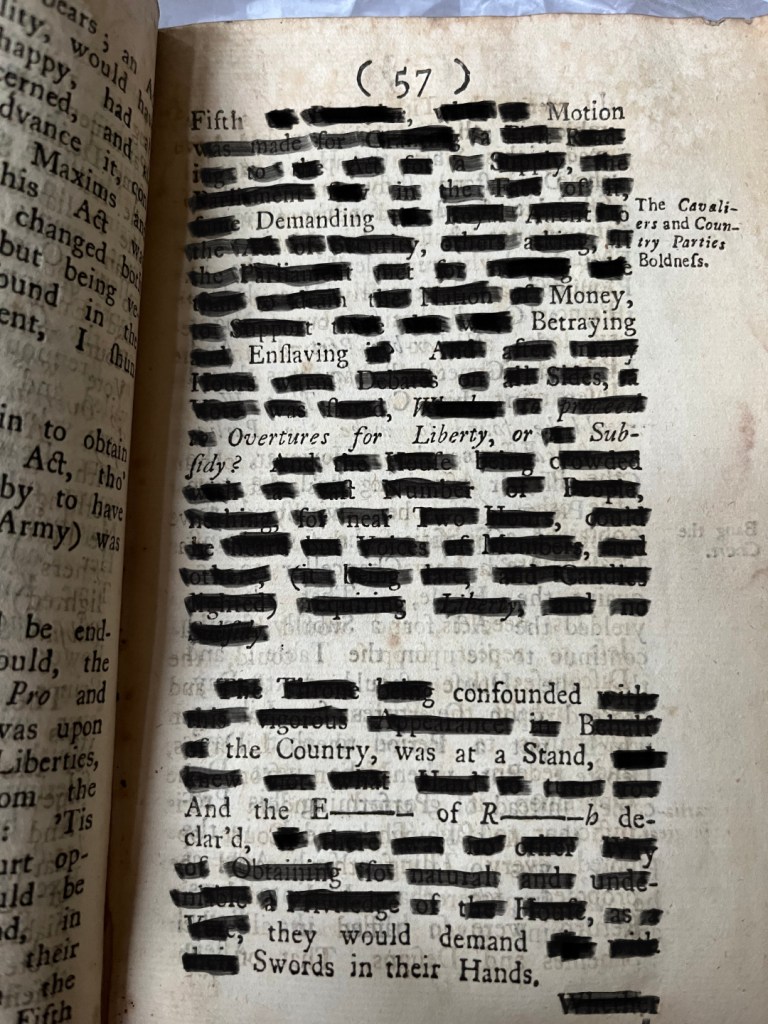
Motion
Demanding
Money
Betraying
and enslaving
Overtures for Liberty
or subsidy?

confounded

the Country,
was at a Stand
And
the E____ of R________h
declar’d,
they would demand
swords in their Hands

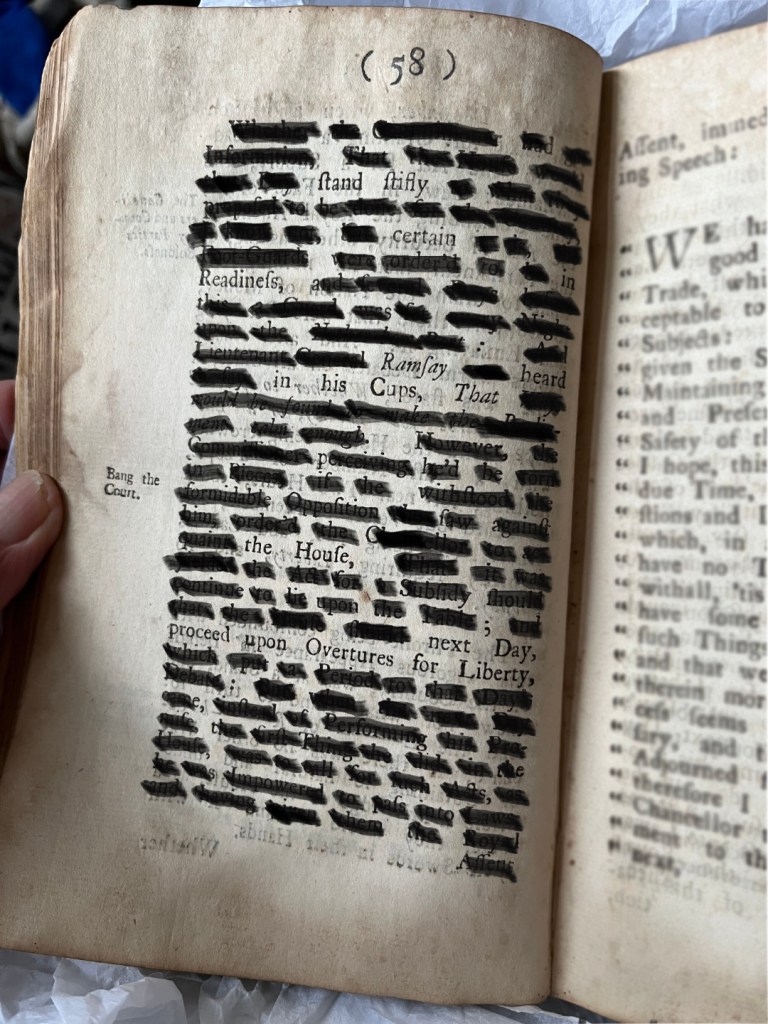
stand stiffly
certain
in Readiness,
Ramsay
heard to say
in his Cups
that the House
next Day,
proceed upon
Overtures for Liberty

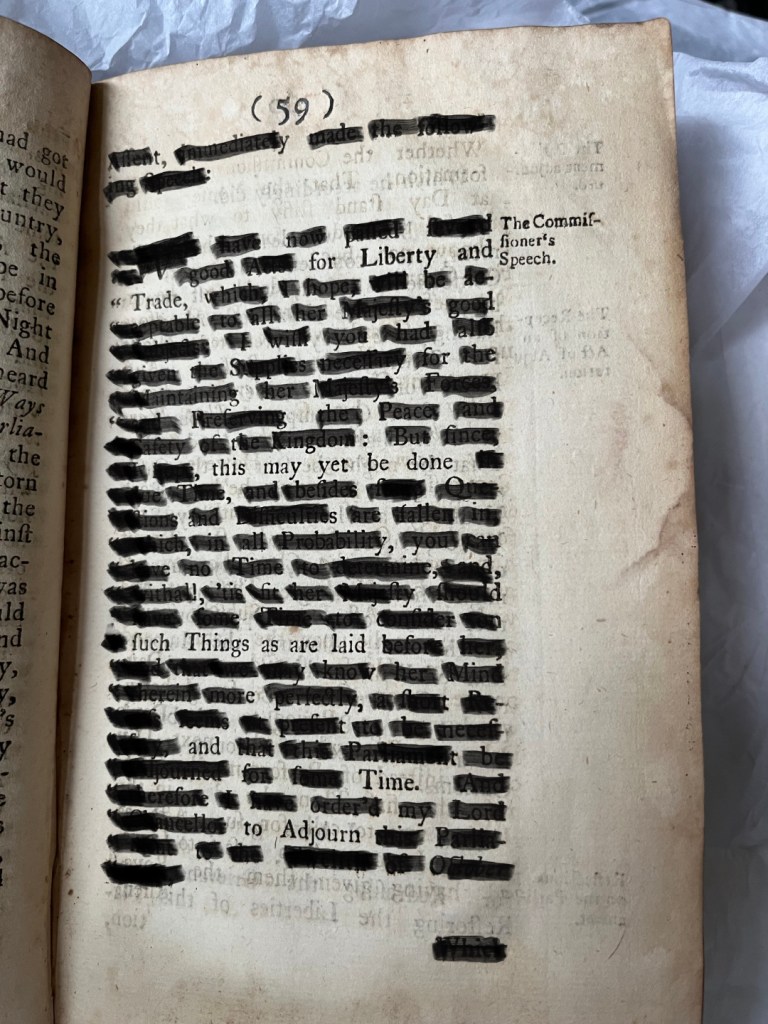
for Liberty and Trade
this may yet be done
such things as are laid
and
Time
to Adjourn


—Lesley Scoble, February 2026
Audio: The E____ of R__________h
Ideally, this would be spoken by a solemn male voice—an MP, clerk, or witness from the early 18th century, recording events amid the Jacobite rebellions. But I hope you’ll enjoy this AI interpretation all the same.
Slideshow
The slideshow below shows the redacted pages, 54 through 59, and reveals the words that form my erasure poem.
A note on my copy of this book
My copy lacks its front cover, but retains the back cover and with the exposed spine cords show that it was issued in a very plain, temporary state, sold in what are known as drab boards. It had no leather covering and was intended to be rebound by the purchaser. It is the third edition, which is actually rarer than the first because fewer copies were printed. The fact that the book reached a third edition indicates that this controversial work was popular.
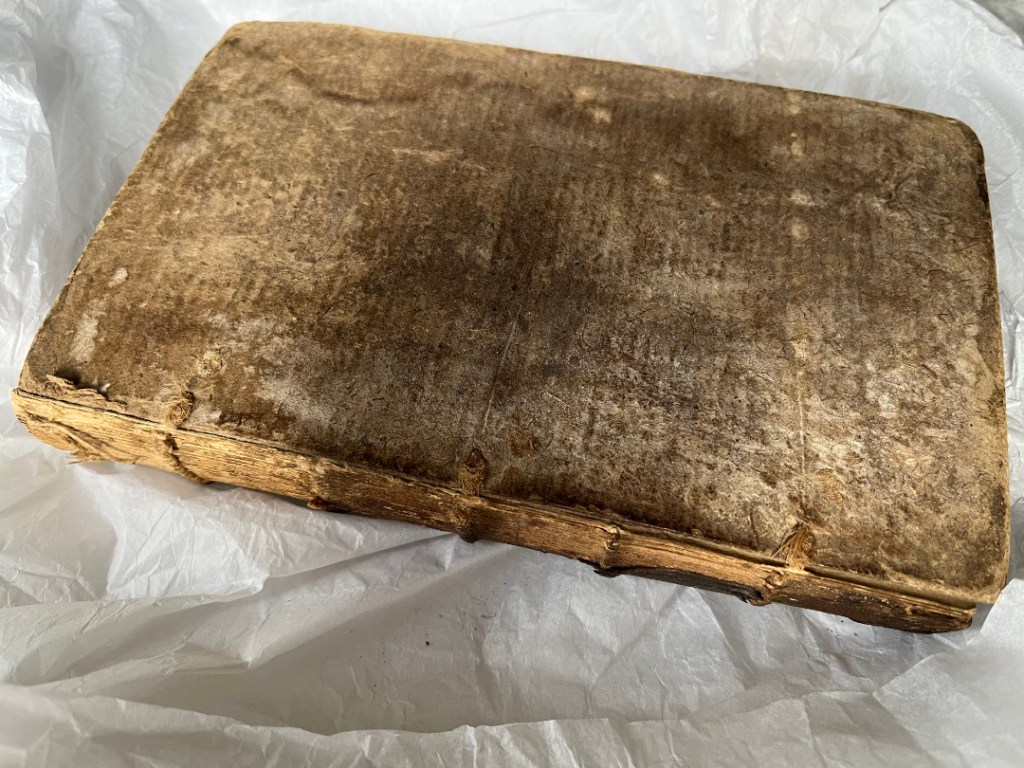
How did I come to possess this rare book?
Once upon a time, I lived for a while in a Spanish pensión called the Bellavista in Puerto de Andraitx, Mallorca, where I was working hard at being a penniless artist. There was an art gallery in the square that sold my paintings, and I managed to earn just enough to pay for my room and café con leche. The gallery owner gave me tips about buying land and a mooring ring in a marina that hadn’t yet been built. Naturally, I paid no heed—advice that would have made me a fair amount of dosh in the distant future.
I was happy enough painting and gazing out at the azure Mediterranean. At that time, I was a compulsive sketcher of people. I would sit in bars and cafés making rapid drawings. These sketches kept me afloat in pesetas (and refreshments). Once, I sketched a scruffy little dog that wandered into the bar. It took only moments to draw, but even I considered it one of my best. I gave it to the delighted owner, who at once ordered a free tab for me for the rest of the night. That scruffy dog gave me the biggest hangover of my life.
One evening in Fornalutx, a village in the north of the island, I found myself at a rather special dinner party, seated at the foot of a long table. It was a lively gathering of friends and intriguing strangers—enough people, in fact, to recreate Leonardo da Vinci’s Last Supper. From where I sat, I had a perfect view of them all, and before long I was sketching in ink directly onto the tablecloth. (It was paper.)
The hosts insisted I give them the drawing. I parted with it reluctantly, signing my name beside the red wine stain where my glass had stood. It’s one of the few sketches I truly wish I still owned. I would love to look at it now and remember every face from that night.
I may have taken a photograph of it with my old Pentax, but I could never afford to develop the roll. In those days I had an entire box of undeveloped film—little time capsules I never got to open.
What has this got to do with my old rare book? Well, one day I was sitting at a café by the port of Andraitx and sketched a local Spaniard. He said the portrait was too special for a few measly pesetas and that he had something more valuable to give me at his villa (I know what you’re thinking). But he seemed sincere.
The villa was inland, in the old town of Andratx. The doors were massive, made of sturdy dark wood, opening into a grand hall lit by gently glinting chandeliers. The Spaniard asked me to wait while he fetched something.
I looked around at the grandeur. Beautiful paintings lined the walls—ancestral, by the look of them. When he returned, he was holding an ancient book.
“Here,” he said. “This is for you. It is in English—I can’t read it.”
He placed it on a large oaken table.
My eyes lit up. I stepped forward to pick it up, eager to feel the weight of it—
and in a flash he stabbed it with a dagger.
Straight through the flyleaf.
Down to page fifteen.
Ooer.
I was somewhat alarmed. What on earth should I do now? One thing was certain: I wasn’t leaving without the book.
I have always been good at talking my way out of awkward situations—and I am here today as proof that I survived my encounter with this wealthy, mad Spaniard. I promised to meet him the next day, though by morning I found myself on urgent business far away in Palma instead.
I never saw him again.
Every time I pick up the book, I look at the tiny, sharp puncture wound just above the to on the title page—right through to page fifteen.
—Lesley Scoble
THANK YOU
My thanks to Shaun Tenzenmen for his absorbing erasure‑poetry prompt.
My thanks, as always, to David Bogomolny of The Skeptics Kaddish for his inspiration and encouragement.
And my thanks to you, the reader, for spending time with my poem and writings.


 LesleyScoble.com
Leave a reply to lesleyscoble Cancel reply