
I wrote my poem Be a Lighthouse for this week’s W3 Poetry Prompt #203, hosted by poet of the week Dennis Johnstone. His prompt invites us to be the lighthouse in a poem of 20–25 lines. Full guidelines are linked below.
Dennis’s prompt: Be the lighthouse
For this week’s prompt, you are the lighthouse.
Write a poem in which the speaker is a lighthouse guiding something away from danger, toward safety, or both.
You can approach this in several ways:
- Literal lighthouse: A real coastal structure doing its job. Keep the poem grounded in the physical reality of the lighthouse itself—its structure, machinery, light, weather, and surroundings.
- Metaphorical lighthouse: The lighthouse stands for a guiding force in life: a person, principle, warning voice, memory, or moral compass. The poem explores what it means to hold that position and what it costs to remain visible.
- Illusory lighthouse: The speaker believes they are guiding others, but the situation may be uncertain. Perhaps no one is watching; perhaps the signal reaches no one.
- Delusional lighthouse: The speaker is convinced they are performing a vital guiding role, though others may see something very different.
- False lighthouse: A darker possibility: a beacon that misleads. Historically, false lights were sometimes used to lure ships onto rocks. Your lighthouse might deceive, misdirect, or shine in the wrong direction.
Whichever path you choose, stay close to your lighthouse idea. The poem should clearly show how the speaker functions as a beacon.
Guidelines
- 20–25 lines maximum
- Choose a form that suits the subject
- Build the lighthouse through concrete images, actions, and sensory detail rather than abstract statements
As you write, ask yourself: What does your light reveal, warn against, or guide toward?
- Click HERE for my example, slightly longer than the prompt, which imagines a lighthouse that may not be entirely necessary.
Be a lighthouse
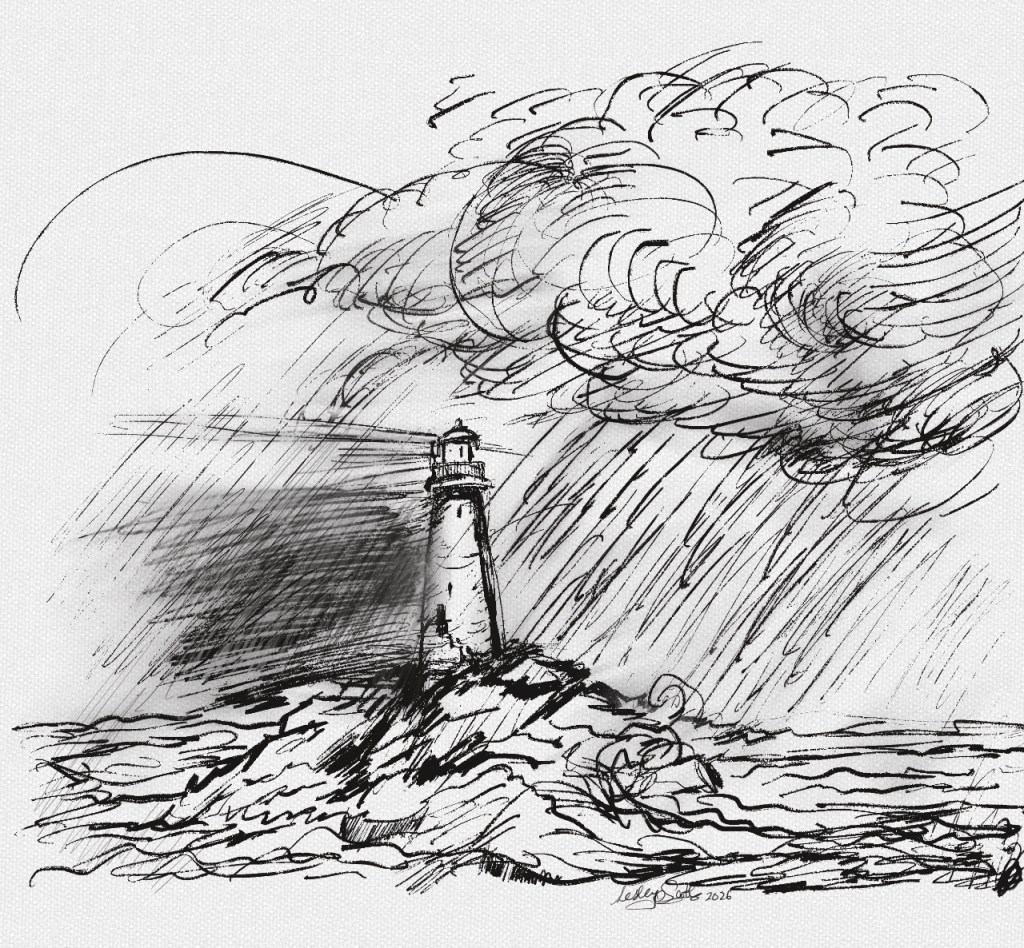
Be a lighthouse
I stand completely still
my arms straight down my side
my eyes closed
I barely breathe
I turn my body
45 degrees
legs straight—knees
unbent
I open my eyes
I see a storm and blink
swivel on stiff legs
shut my eyes
I hear waves crashing
against dark rock
carving caves
I open my eyes
and blink again
rain lashes my lashes
I blink and turn
the storm spent
high tides
subside
I open my eyes.
Well done, my drama teacher says.
—Lesley Scoble, March 2026
Audio — Be a Lighthouse
Method Acting and the Lighthouse
In my poem, the lighthouse isn’t a tower at all but a body learning how to be one. This is pure Method territory: the actor doesn’t imitate a lighthouse, doesn’t pretend to rotate or shine — they inhabit the stillness, the stiffness, the slow swivel of the beam. Method acting asks the performer to locate the truth of a thing inside their own physical experience, and that’s exactly what I hope my poem enacts.
The closed eyes become the shutter of the lantern.
The blink becomes the flash of light.
The stiff legs become the fixed column rooted to rock.
By committing fully to these gestures, the speaker discovers the lighthouse from the inside out. And the drama teacher’s quiet “Well done” at the end reminds us that this is a study in embodiment — a lesson in how an actor can transform through attention, breath, and the smallest calibrated movement.
My poem becomes a demonstration of Method acting’s central belief: that truth is found not in grand performance, but in the disciplined inhabiting of a role until the boundary between self and symbol briefly dissolves.
In drama class, I was once asked to enact a chair. I won’t describe the choices I made to inhabit the role — some things are best left to the imagination — but I can assure you my performance received a standing ovation.
Timelapse Video
Here’s a 20‑second timelapse of the lighthouse sketch taking shape in digital ink.
THANK YOU
Warm thanks to Dennis for his wonderful prompt,
and to David for hosting W3 We’ave Weekly Poetry Prompts.
And thank you, dear reader, for spending time with my poem.




 LesleyScoble.com
Leave a reply to seanatbogie Cancel reply