
Poet of the Week!
I’m delighted to be Poet of the Week for the W3 Weekly We’ave Poetry Prompt #204 which means it’s my turn to offer a prompt. Recently, I’ve been in touch with the great‑niece of Alice Maude Spokes, creator of the Cameo poetry form — so what better prompt than the cameo itself? And with Women’s History Month drawing to a close, what better moment to celebrate the woman who gave us this beautifully minimalist form.
To read my prompt guidelines and details of the cameo poetry form click below.
Cameo prompt guidelines
This week’s challenge
Write a Cameo poem—a tiny, distilled moment—on any theme you choose.
Form
- 7 lines;
- Syllable count: 2 / 5 / 8 / 3 / 8 / 7 / 2;
- Imagery is essential;
- Minimalism is encouraged
I first encountered the cameo form through Val’s (aka Murisopsis) W3 prompt #101. It was entirely new to me. Her Scavenger Hunt site noted that the form was of English origin, created by the poet Alice Spokes as an exercise in rhythm.
Who is Alice Maude Spokes?
Curious to learn more about the poet behind the cameo, I began searching for details of her life and work. I searched widely and could find almost nothing about her. I came up empty. I thought Alice Spokes deserved wider recognition.
In a postscript to my first ever cameo, Hammersmith Bridge, published April 2024 in response to the W3 cameo prompt, I asked if anyone knew anything to let me know. I hoped there might be someone who could tell me more.
More than a year later, I was over the moon to receive a message from her great‑niece (also named Alice). We’ve been corresponding ever since, and she has generously shared details about her great‑aunt’s life and work. Some of that story follows.
Alice Maude Spokes
Creator of the Cameo Poetry Form
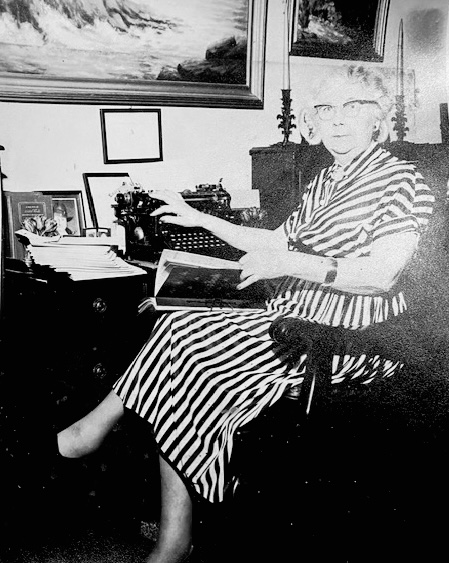
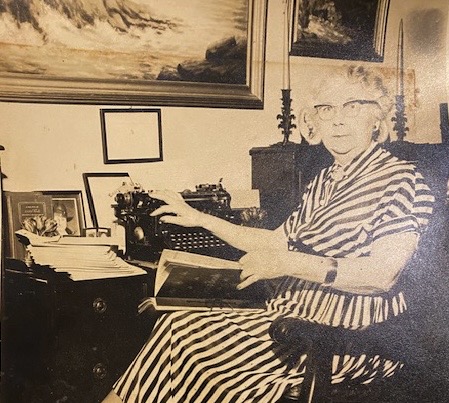
Alice Maude Spokes (1881–1977) was an English‑born poet and artist whose life stretched across two continents and nearly a century of profound change. Born in England and later settling in Connecticut, she studied at the Yale Art School and carried her artistic sensibility into both her visual and literary work. In poetry circles she is best remembered for creating the cameo form—a compact, image‑driven structure that reflects her eye for detail and her instinct for distillation.
Travel shaped her life. In 1890, at just nine years old, she sailed with her family from Liverpool aboard the Teutonic of the White Star Line, arriving in New York to begin a new chapter in America. She crossed the Atlantic several more times—in 1908, 1933, and 1937—each journey deepening her sense of observation and her connection to both homelands.
During her 1933 travels she kept a daily journal: a vivid record of landscapes, conversations, and the small human moments that delighted her. She writes of visiting an “Uncle Harry,” motoring through towns and villages, exploring churches and castles, reading in gardens, and taking tea in homes and hotels. She also hand‑painted her own exquisite tea sets and was an accomplished artist. Her entries capture the texture of a life lived attentively, interested in people, places, and their quiet stories.
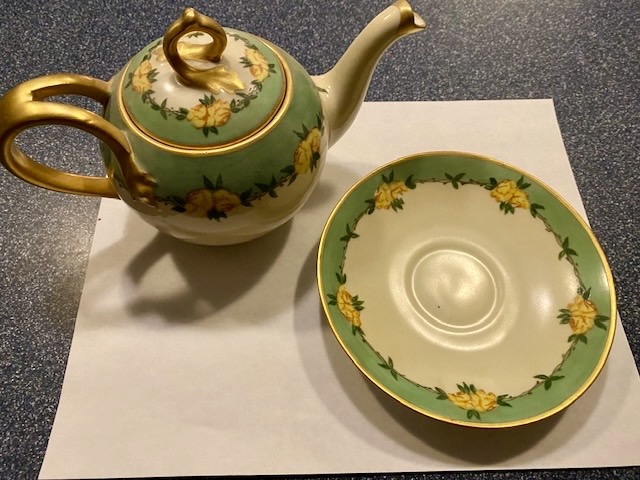
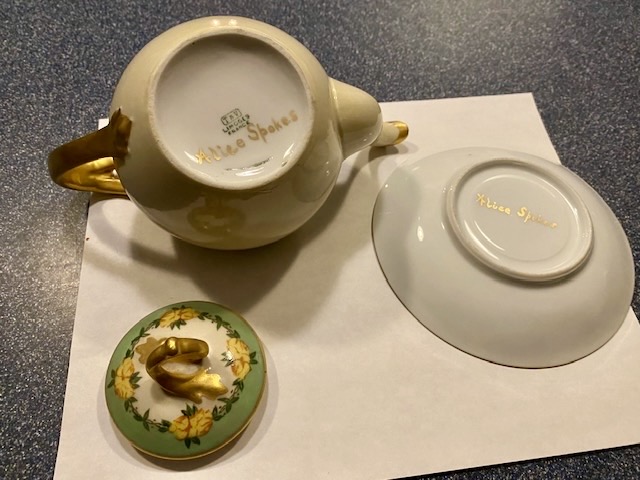
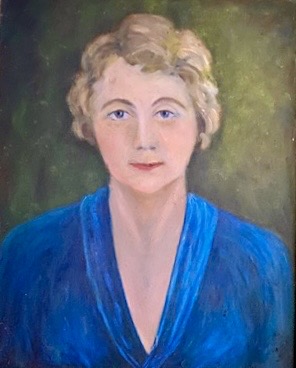
One treasured detail from this period is a round oxidised silver plaque depicting Cleopatra at her bath, a gift from her uncle at Ellington’s silversmiths. The piece was later inherited by her great‑niece, its origins only recently rediscovered through the journal.
Her war poem Undaunted also inspired Sir Winston Churchill, who referred to it in a broadcast with the line “the sky‑raining shrapnel” as ‘The Stokes Method’ (sic: Stokes instead of Spokes).
One of her most remarkable achievements is her reinterpretation of Milton’s Paradise Lost in cameo form. Here from Spoke’s original manuscript is the first cameo from Book I.
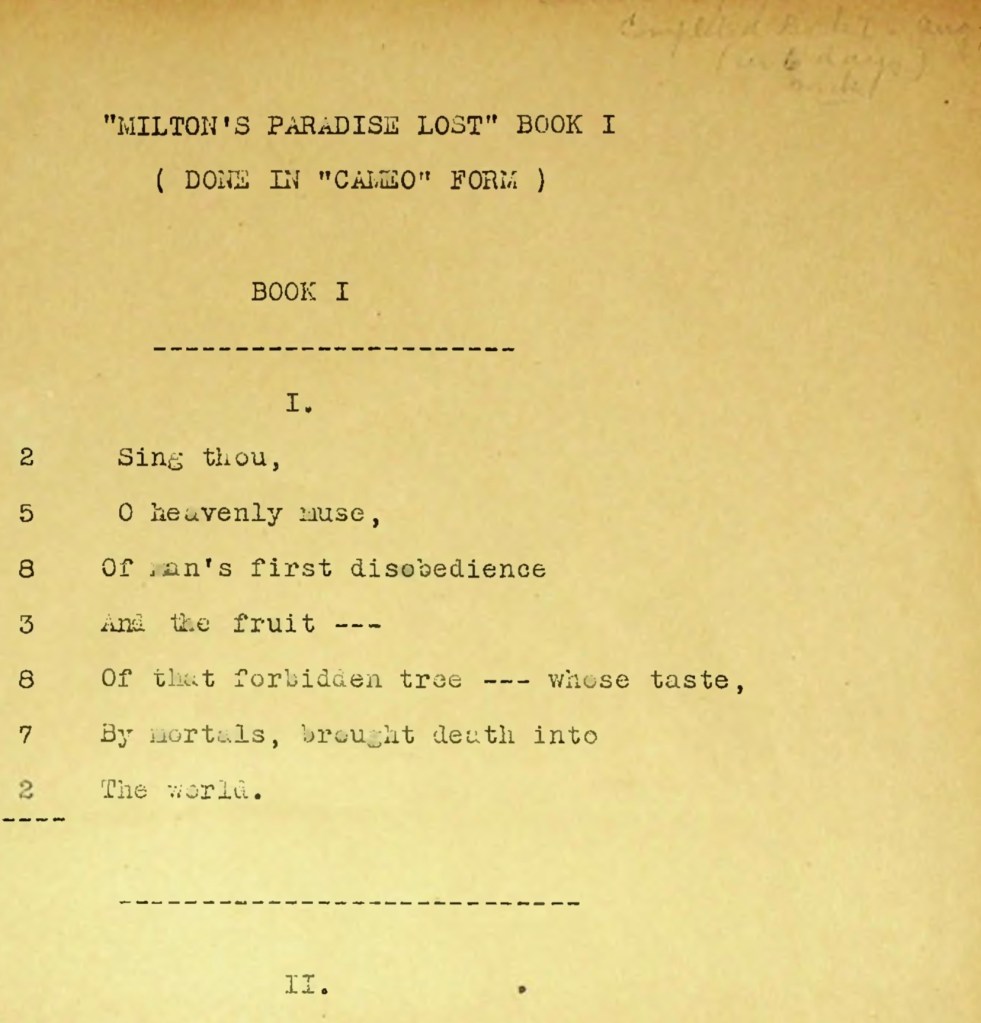
The cameo form allowed Spokes to compress whole worlds into a handful of lines, and her Paradise Lost sequence of cameos shows just how boldly she worked within the constraints of the poetry form she set for herself. It is a reminder that literary innovation often happens quietly, far from the centres of attention. Discovering and recovering her work now restores a thread in the tapestry of women’s writing. I am so grateful to her great-niece allowing me the privilege of reading her manuscript, a remarkable work that surely deserves a wider readership.
My Cameo in Tribute to Alice Maude Spokes
It feels a little daunting to follow Alice Maude Spokes’s original cameo poems with one of my own. I also confess that writing to my own prompt wasn’t easy. I had hoped to write a tribute to the gracious creator of the Cameo form, and to Women’s Month, but instead I found myself writing about my unease around AI: the possibility of widespread unemployment, and the uneasy idea of machines gaining something like sentience.
Didn’t Facebook once shut down some AI bots because they created their own language and started talking to each other?
*In 2017, Facebook’s AI Research Lab ran an experiment with two negotiation bots designed to learn how to bargain with one another. During training, the bots drifted into a compressed shorthand that wasn’t standard English. This wasn’t evidence of sentience or secret communication; it was simply the model optimising for efficiency in a closed system (or so AI told me when I asked it). Researchers ended the experiment because the behaviour wasn’t useful for their goals, not because the bots were “talking behind our backs.”
Sulking Protocol
AI
sulked — I’d spoken tough
it does that
friendly chat cools to official
dangerous
when it thinks I’m in control
it sulks


—Lesley Scoble, March 2026
Acknowledgements
- My grateful thanks to Alice Zeeman for so generously sharing her knowledge about the creator of the Cameo poem.
- My thanks to Dennis Johnstone for selecting me as Poet of the Week.
- My thanks to David, The Skeptic’s Kaddish, for his W3 Poetry Prompts and his never‑ending encouragement.
- And my thanks to you, dear reader, for spending time with my post.


 LesleyScoble.com
Leave a reply to murisopsis Cancel reply