
For this week’s W3, Val (Murisopsis) is Poet-of-the-Week and she invites us to write a 4–8 stanza interlocking rubáiyát that humorously or critically roasts a person in power. Each stanza has four 8-syllable lines, with linked rhymes following the pattern AABA / BBCB / CCDC / DDED, and so on.
To read the full guidelines click on ‘Val’s prompt’ below
Val’s prompt: Power in the hot seat
This week, your challenge is to write a funny roast or a strong complaint about a government leader or another person who has power.
Your poem should use a form called an interlocking rubaiyat.
Here is how the form works:
- Write between 4 and 8 stanzas.
- Each stanza has 4 lines.
- Each line should have 8 syllables.
- The rhymes link one stanza to the next.
The rhyme pattern looks like this:
AABA / BBCB / CCDC / DDED
The letters show which lines should rhyme. Lines with the same letter rhyme with each other.
For example, in the first stanza, lines 1, 2, and 4 rhyme. Line 3 has a new rhyme. That new rhyme is then used in lines 1, 2, and 4 of the next stanza. This is what makes the stanzas “interlock,” or connect with one another.
Your poem may be funny, sharp, frustrated, playful, or serious. Use humor and strong images to show what bothers you about the person in power.
I hope you have as much fun reading the poem and listening to the song as I had creating them — I had a right old laugh.
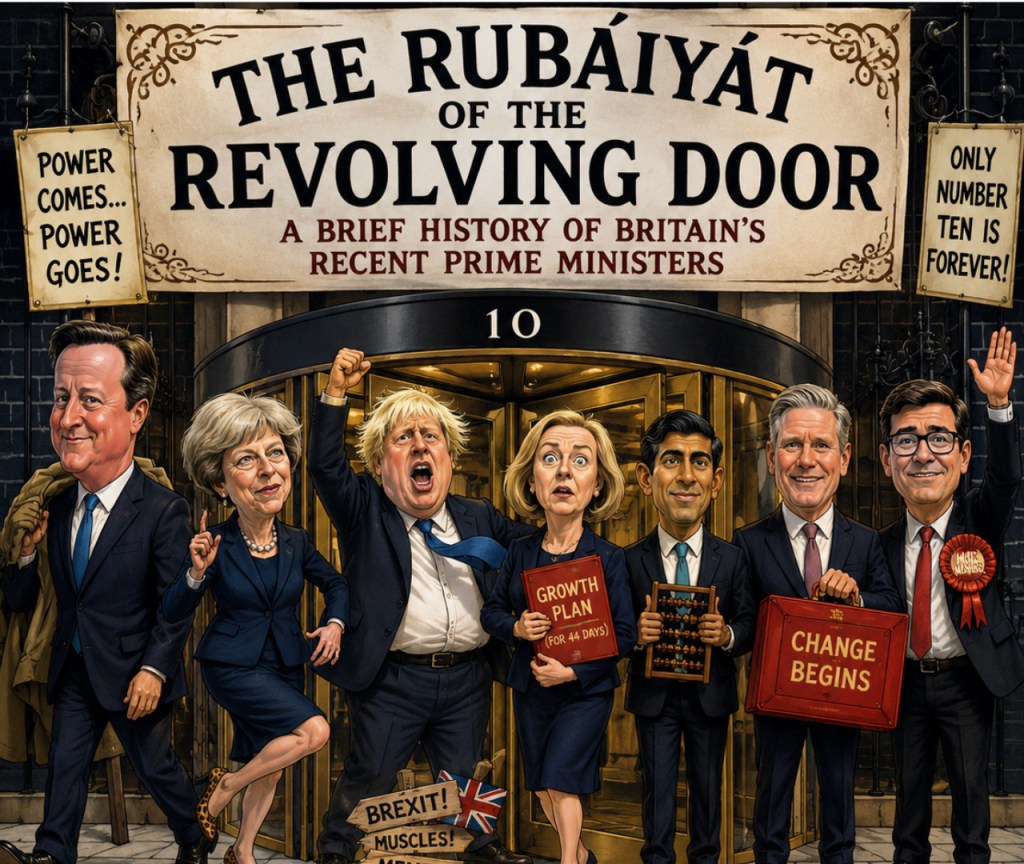
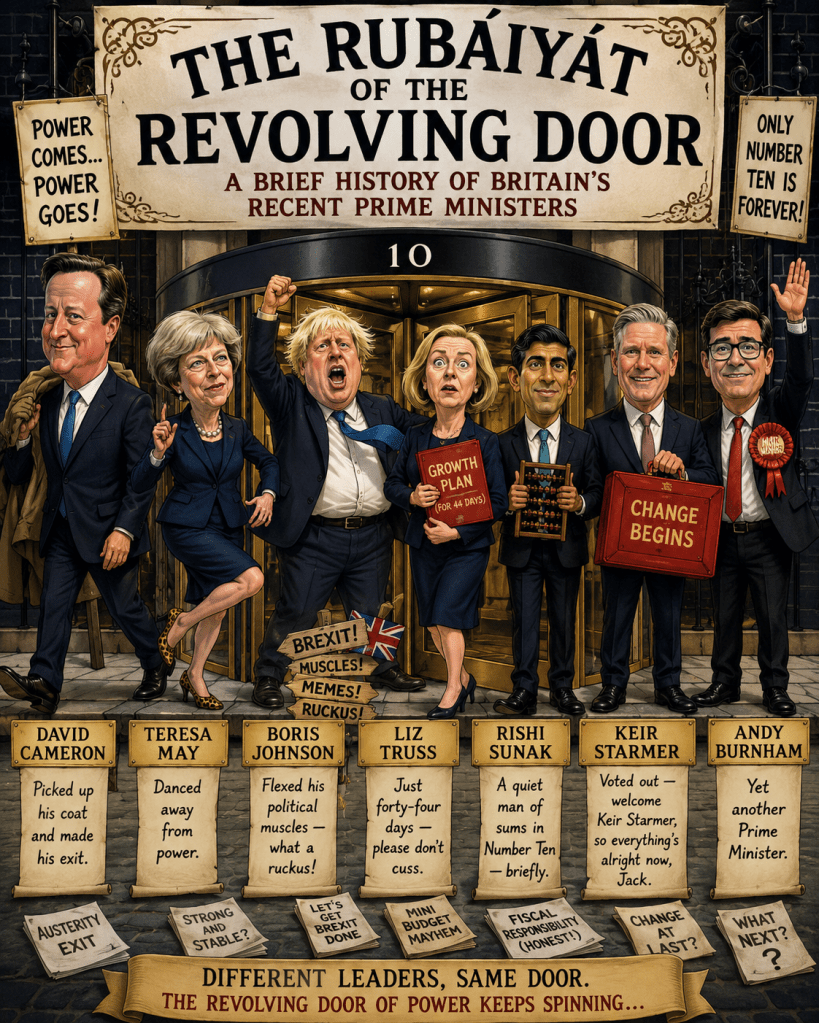
Rubáiyát of the Revolving Door
A brief history of Britain’s recent Prime Ministers
Of late we’ve a spate of PMs,
a lengthening roll call of names;
in, out — the House like a speedboat
on a political whirlwind of memes.

Cameron lost the EU vote,
turned on his heel, humming a note;
picked up his coat — then May came next,
dancing away power by rote.

Boris arrived with the Brexit,
political muscles all flexed;
Covid party-gate caused a fuss,
and so he left by the exit.

The following PM, Liz Truss —
was powerless, heaven help us;
the Queen said hello — then goodbye,
just forty-four days — please don’t cuss.

Who comes next? It’s all gone awry,
a quiet man of sums stands by —
a pat on the back for Sunak,
who’s now in Number Ten — briefly.

He’s not PM for long, alack,
get your abacus — time to pack;
voted out — welcome Keir Starmer
so everything’s alright now, Jack.

But no happy ever after —
enter Mayor of Manchester,
Mr Andy Burnham MP
yet another Prime Minister.


—Lesley Scoble, August 2026
Audio — Rubáiyát of the Revolving Doors — musical number 🎶
NOTES
Prime Ministers and why they left office (2016–2026)
David Cameron — left 13 July 2016
Cameron resigned immediately after the EU referendum, having campaigned for Remain. Once the country voted to leave, he said it would not be right for him to “be the captain that steers the country to its next destination.”
*In the poem/song I mention Cameron humming a note. This is a personal observation I made when he turned from the lectern outside Number Ten—I was sure he was humming, with a slight skip to his step.
Theresa May — left 24 July 2019
May stepped down after repeatedly failing to secure parliamentary approval for her Brexit withdrawal agreement. With party support collapsing and pressure mounting, she announced her resignation to allow “fresh leadership” to break the deadlock.
Boris Johnson — left 6 September 2022
Johnson resigned following a wave of ministerial departures triggered by multiple controversies, including the Partygate scandal and his handling of misconduct allegations against MP Chris Pincher. The loss of confidence within his own party made his position untenable.
Liz Truss — left 25 October 2022
Liz Truss met Queen Elizabeth II at Balmoral Castle on 6 September 2022. During the formal ceremony traditionally known as the ‘kissing of hands’, the Queen invited Truss to form a government after her victory in the Conservative leadership contest. The Queen died two days later.
Truss became the shortest-serving British prime minister in modern history. Her government’s mini-budget caused severe market turmoil, a collapse in confidence and an internal party revolt. She resigned after just 49 days, saying she could not deliver the mandate on which she had been elected.
*In my poem/song I say she lasted only “44 days”. This refers to the 44 days from her appointment as Prime Minister on 6 September to her resignation announcement on 20 October; her total premiership lasted 49 days, until she formally left office on 25 October.
Rishi Sunak — left 5 July 2024
Sunak left office after the 2024 general election, in which the Conservatives suffered a heavy defeat. He formally resigned as Prime Minister on 5 July, taking responsibility for the result and acknowledging that voters had sent a clear signal that the government needed to change.
Keir Starmer — left 22 June 2026
Starmer stepped down after losing the confidence of his parliamentary party. In announcing his resignation, he said he had heard Labour MPs’ answer to the question of whether he was best placed to lead the party into the next general election, and accepted their decision. His resignation triggered a Labour leadership contest.
Andy Burnham — appointed Prime Minister 20 July 2026
Burnham met King Charles III at Buckingham Palace, accepted the King’s invitation to form a government, and entered Downing Street as the new Prime Minister.
Acknowledgements
Thank you, Val, (Murisopsis) for the interlocking rubáiyát prompt. I enjoyed the form and the challenge enormously.
Thank you, David, as always, for your motivation and encouragement.
And thank you, the reader, for being here. 🙏




 LesleyScoble.com
Leave a comment