


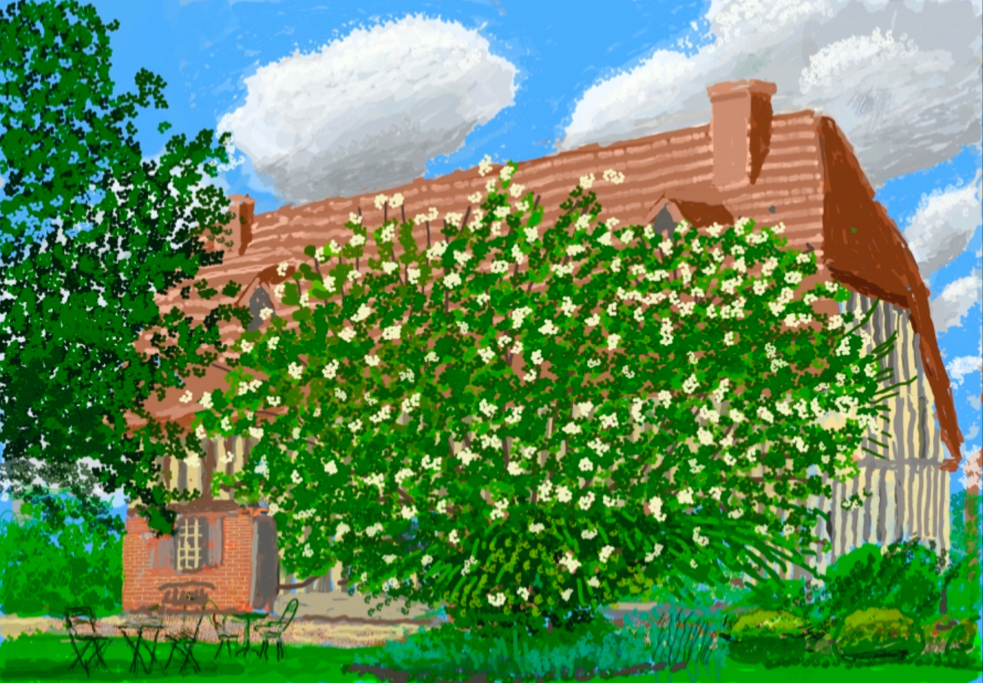
David Hockney The Arrival of Spring, Normandy, 2020
Under an overcast sky, threatening rain, my eldest son and I set off for the David Hockney exhibition The Arrival of Spring, Normandy, 2020 at the Royal Academy, Burlington House. I’ve wanted to see this show ever since it opened. Thwarted by Covid restrictions and bouts of extreme heat, today is at last the day we can make the visit.
In the gallery
Entering the exhibition the first thing you see is a screen showing a video of No. 262 28th April 2020 iPad painting with a drawn animation of rain. I love it! And I can’t wait to have a go using animation on my iPad …Once upon a time, long ago, I used to animate the old‑fashioned way, with numerous hand‑drawn cels on acetate.
I’ve painted a Mockney!
Unable to show you the David Hockney animation (you’ll have to go to the RA to see that) I’ve mocked up my own version: a rainy scene in Sandy, Bedfordshire, titled 01, 29th July 2021. The titles of all 116 of Hockney’s paintings in the exhibition are simply numbers and dates. They form a kind of lockdown journal, and none of them has a name.
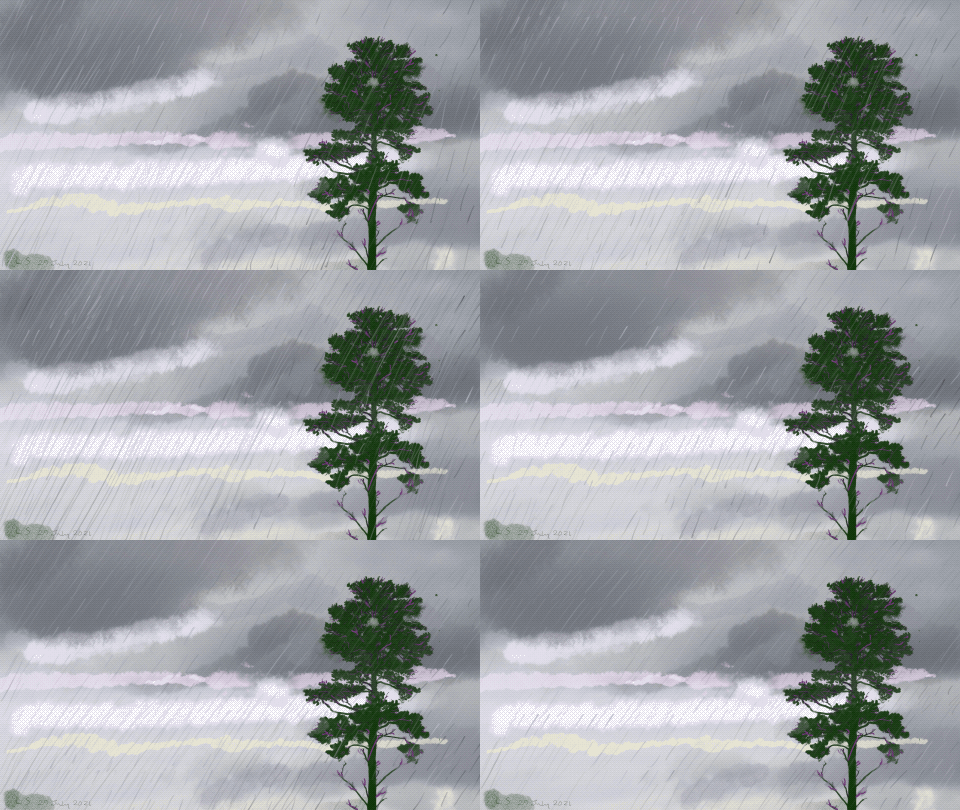
My iPad painting of rain isn’t as bright as Hockney’s, with its pink path and yellow rain. I’m afraid I need to venture further into my synesthesia zone (see paragraph below) and work on the bolder colours… or perhaps I simply need to live in France.
David Hockney The Arrival of Spring, Normandy, 2020
My first impression of this exhibition is one of brightness and joy — colours so bold they lift the spirit.
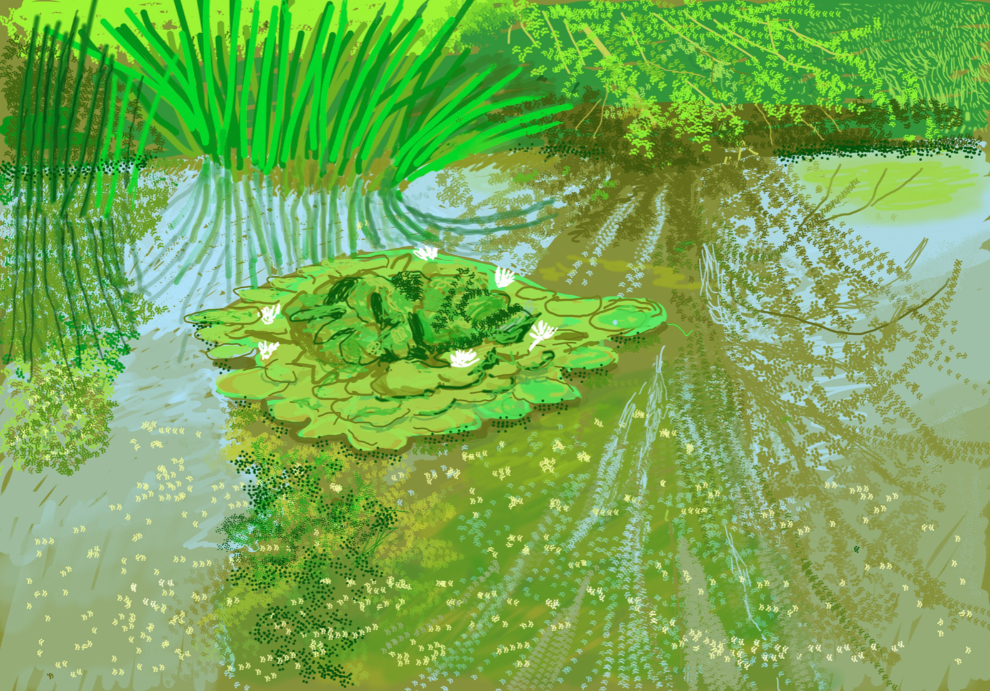

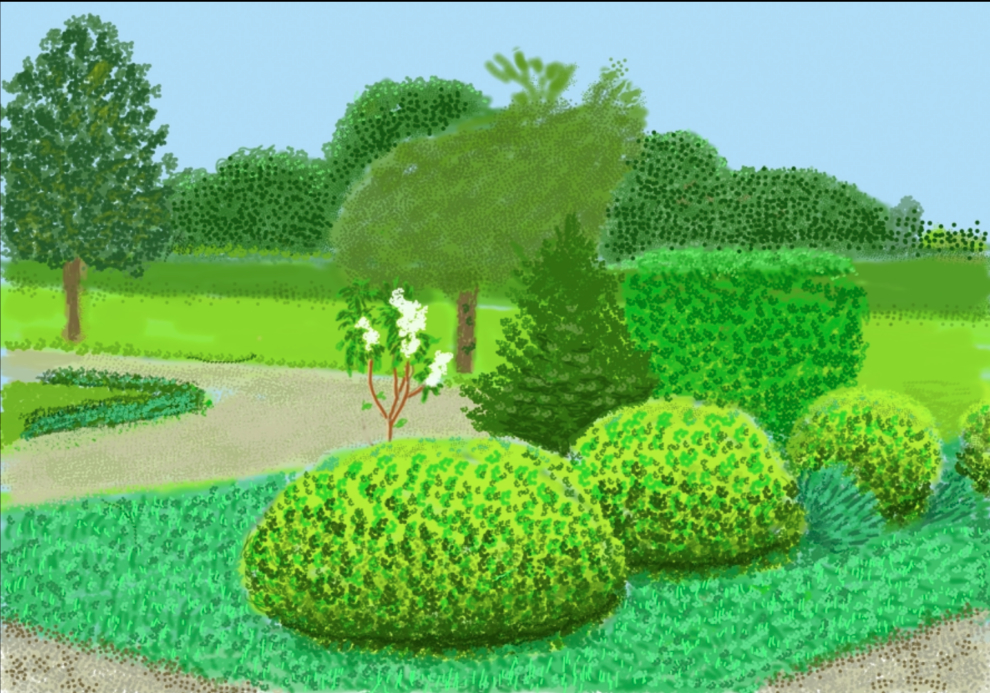
©️ David Hockney, iPad paintings
I gaze around the gallery at Hockney’s paintings of his days in Normandy during lockdown, and I find myself enjoying the comments drifting from other visitors (I’m prone to accidental eavesdropping). “He’s a genius” came up more than once.
The word “simple” surfaced too.
Simplicity is not a simple thing to achieve. I find the pared‑back directness of the paintings a delight. Some negative critics have dismissed the work as childlike. What was that famous Picasso line about spending a lifetime learning to draw like a child?

“It took me four years to learn how to paint like Raphael, but a lifetime to paint like a child.”
— Pablo Picasso
*Synesthesia
Why have I mentioned synesthesia? I’m wondering whether it has anything to do with the desire to paint in a bright, seemingly childlike way.
Synesthesia is a sensory phenomenon normally found in babies of around two to three months old, and it typically fades by about eight months. That suggests to me that Picasso worked hard to reclaim those early months — a time when an infant can, in a sense, taste and feel colour. Perhaps David Hockney, in these recent works, is reaching for something similar.

Synesthesia is a condition in which the senses intermingle — you might taste or feel colours, or see sound. Apparently, over seven percent of adults with synesthesia are artists.
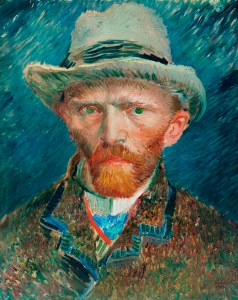
Van Gogh suffered from what we now recognise as Bipolar Disorder. It’s possible he was also a synesthete. Synesthesia isn’t a mental illness, but he may have had this neurological mixing of the senses, which could help explain the extraordinary intensity of the colours he’s so famous for.
But just because an artist favours bright colours doesn’t mean he’s carried a babyhood sensory state into adulthood. Hockney may simply enjoy lifting our spirits with colour during one of the bleakest lockdown periods of our lives.
iPad painting of the moon
In the RA catalogue, David Hockney — in conversation with Edith Devaney — explains how the backlit iPad allows him to paint in the dark: “If you did the drawings on paper, you’d need light on the paper; you can’t work in the dark out there. But on an iPad you can, because it’s backlit.”
Key 93 David Hockney, No. 370, 2nd May 2020 IPad painting ©️David Hockney

Oil painting by the light of the moon (and a bicycle lamp)
When I painted this little oil, the iPad didn’t yet exist.
Puerto de Andraitx in moonlight, oil sketch painted in situ (en plein air)
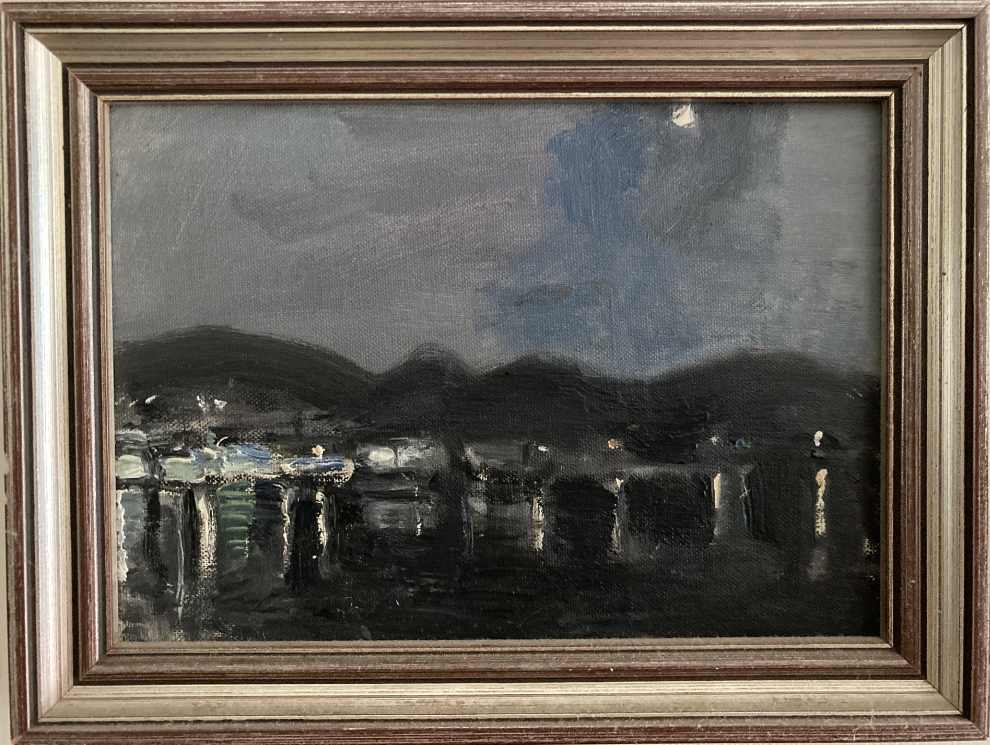
I was alone on a jetty in the Port of Andratx, Mallorca, in the middle of the night, sitting with my feet dangling over the water and a bicycle lamp hooked onto the neck of my T‑shirt. The light was just enough for me to see what I was doing and sort out the paraphernalia of paints, brushes, turps, and so on (no iPad).
I was alone with the landscape and the moon — until two Spanish police officers on night patrol approached and began chatting, asking if I was alright.
“I was alright till you turned up,” I said, irritated.
They meant well, of course, but I was doing a Greta Garbo and wanted to be alone.
Finally, when the two police officers moved on, I resumed painting, stopping only when the battery of the bicycle lamp gave out.
I shall never forget the beauty of that Mallorcan summer night.
When you paint outside en plein air, you always remember the smells, the atmosphere — the where, the when, the exact moment of what you saw.
*Greta Garbo, film star, quote “I want to be alone” from 1932 film Grand Hotel.
iPad Art
Ever since I got my first iPad, I’ve loved digital art and enjoy drawing with the most expensive pencil in the world — the Apple Pencil. Shakespeare’s Hamlet may ask the question, ‘2B or not 2B?’ (note the pun), but the iPad will give you any pencil you want, along with an entire cabinet of brushes at its tip.
I sometimes contend with remarks from traditionalists who insist it’s ‘a cheat’ to paint on an iPad. Is it cheating? It’s a remarkable tool for artistic expression, and it certainly isn’t as easy as it looks.
So what? It’s the result that counts, isn’t it? I can’t imagine Leonardo da Vinci turning down the chance to design his helicopter on one — or to capture yet another version of the Mona Lisa’s smile.
Digital reproduction
To display iPad paintings, you either show them on a screen or print them. There has been criticism that prints can lose the luminosity an iPad screen gives the images, but I liked the quality of the prints at this exhibition. The works hang in simple frames and are enlarged from iPad dimensions to an exhibition‑friendly size of roughly 1.5 × 1 metres. The printing is on a smooth, matt surface, giving the images a slightly chalky, almost “acrylic‑painty, inkjetty” appearance.

I think that with this exhibition, David Hockney has helped validate the iPad as a professional artist’s tool. Artists can now, with pride, call their work ‘digital art’ without apology. He has helped legitimise the use of the computer in art — perhaps even persuading a few die‑hard opponents and traditionalists.
No Photography
At the request of the artist, photography is prohibited within the gallery — an unusual restriction these days. I suppose one issue with digital art is that it’s far easier to copy and reproduce than it is to fake an oil painting. But that doesn’t mean you’re allowed to do it, of course, and copyright laws still apply.
Scenery painting
All the paintings in this Hockney exhibition are unpeopled. There are no transient living creatures within them — nothing that needs to move, apart from the leaves that might stir in the wind or fall in autumn. No bird in a tree or crossing the sky; no cat curled on a chair. No people. No figures.
They remind me of the brief I was given when I first began painting scenery backcloths for the theatre: “Paint nothing into the scene that can move.” (Don’t tell anyone, but I sometimes slipped in a tiny mouse when I had the time.) Hockney’s pictures seem to follow that very brief. There is nothing in them that would look odd by remaining in exactly the same place half an hour later. They are scenic — pure and simple. Perfect for stage backcloths (or for hanging on your wall, of course).
These paintings are the real‑life backcloths of David Hockney’s home in Normandy.
Stage backcloths
This photo montage from an old portfolio shows me standing in the centre of my backcloth, taking a picture with my old Pentax in the studio workshop at the Theatre Royal, Lincoln. It’s a coincidence that the image echoes Hockney’s collage photographs — it’s simply what you did with 35mm prints to create a larger panorama.

Some of the leaf repeats in Hockney’s paintings reminded me of how we created foliage in woodland scenes, using leaf shapes cut from sponge and fixed to the end of a stick. I imagine his specially formatted paint app includes a brush for a leaf motif — the digital equivalent of our old sponge‑on‑a‑stick trick.

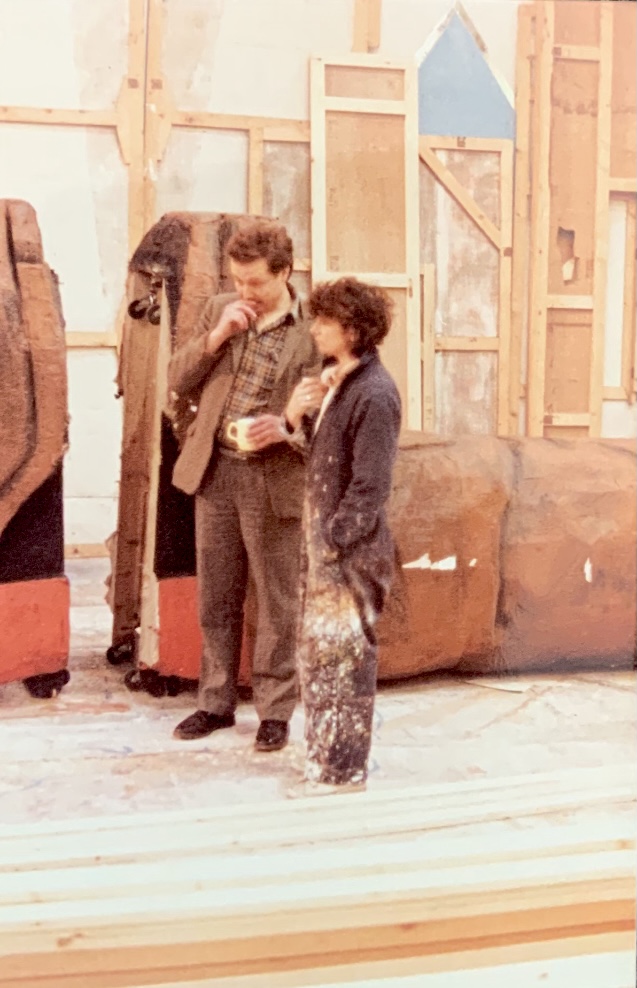
I was a scenic artist at the Theatre Royal, Lincoln, where I painted thirty backcloths — each 50’ × 30’ — in just three months, sometimes working through the night to meet deadlines.
I also painted for productions at the Royal Opera House, Covent Garden, working at the Phil Parsons studio in London.

Heavy rain
Leaving the exhibition and the bright light of the Normandy spring, we step out into Piccadilly — and the heavens open. Rain pours down, sending us in a mad dash for shelter. We dive into The Golden Lion to avoid a drenching.
A young, homesick Italian barman pours us a beer (when the rain is pouring, it’s clearly time for pouring beer) and laments the weather. He tells me how he longs for the tropical sun of last week. I feel sorry for him, imagining him in his bright, sun‑soaked homeland, singing O Sole Mio.

Eventually, after a perusal of the catalogue and a couple of glasses of Wimbledon ale, the time comes to leave the shelter of the pub. The friendly Italian barman waves arrivederci with a hail “Buona giornata” and we leave the pub in a metaphorical ray of Italian sunshine.
Outside, the rain shows no sign of abating. I shrug my shoulders and end up getting my feet wet dancing in a puddle in Green Park.
“When life throws you a rainy day, play in the puddles”.
—Winnie the Pooh
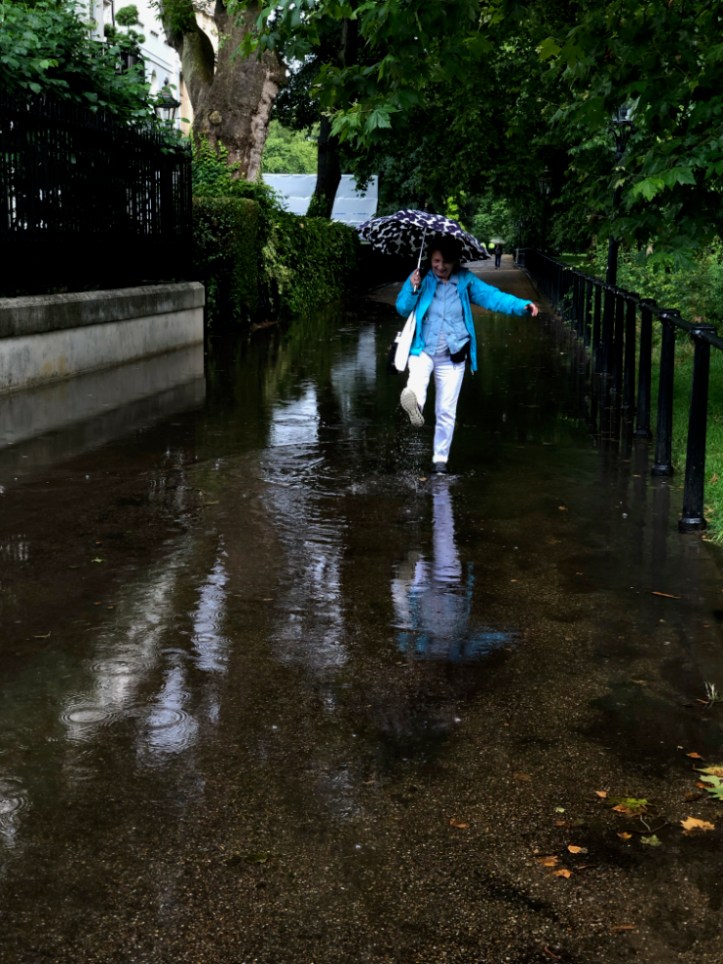
Splishing splashing splosh
Oh my goodness, oh my gosh!
Wearing white trousers in the rain?
Shall I get them clean again?

Feet squelch in sodden shoes
But who cares!

Puddles are for jumping in.


Lesley Scoble, July 2021
Stay safe, and keep your powder dry ☔️
Lesley lives in the City of London Square Mile. An artist, actor and sculptor (her first ceramic sculpture won the V&A inspired by… Award). Scenic artist & book illustrator, playwright, (her musical play, Rapscallion performed in inner city schools and theatre school); TV dancer; Animator and illustrator for TV production. Set up Pinecone Studios Ltd and IIMSI Ltd drama and filmmaking workshops in London – producing award-winning films made by children.



 LesleyScoble.com
Leave a comment