

Wahay! I am the Poet of the Week for the W3 Weekly Poetry Prompt #88. Thank you Lorraine, Blindwilderness for your discerning taste in choosing my poem, MAYFLIES, as your winner. Ahem! ☺️ I am doubly chuffed because I read the other poems and they were all amazing!
Please click below for my prompt guidelines.
Please click here to read my prompt guidelines
Robert Burns (aka Robbie Burns) was a Scottish poet (1759-1796) who wrote in the Romantic style. His works focused on themes of love; A Red, Red Rose, on nature; To a Mouse, and the human condition; Tam O’Shanter.
Please write a contemporary poem inspired by Robbie Burns, choosing from his three themes of Love, Nature and the Human Condition. (You may blend the themes—as in The Banks O’Doon, where Burns combines both love and nature).
Also, Burns is best known for his use of the Scots dialect in his works, showcasing his deep connection to Scottish culture and identity… So, please write your poem, including some local dialect, slang, and/or colloquialism from where you live.
Why did I choose Robbie Burns as the poetic inspiration for my prompt?
I think the New Year’s Eve song, Auld Lang Syne, has something to do with it. Because it’s New Year, and he wrote it. (some say he just wrote an old aural folk song down) Also, it’s his birthday on the 25th of this month. I enjoy Burns Night because a local pub (just off Charterhouse Square) dishes out free whiskies to celebrate. I’d tell you the name of the pub—but it gets crowded enough as it is. Someone always seems to play the bagpipes on Burns Night. Last year, a kilted bagpiper played outside in the street beneath our window.
THEM GREAT BELLS OF BOW is my attempt at writing a poem in Cockney dialect. I think it fits into the theme of the human condition.
Them Great Bells of Bow
I walked past St Mary-Le-Bow the other day and the bells were ringing. I recorded them on my iPhone.
Listen
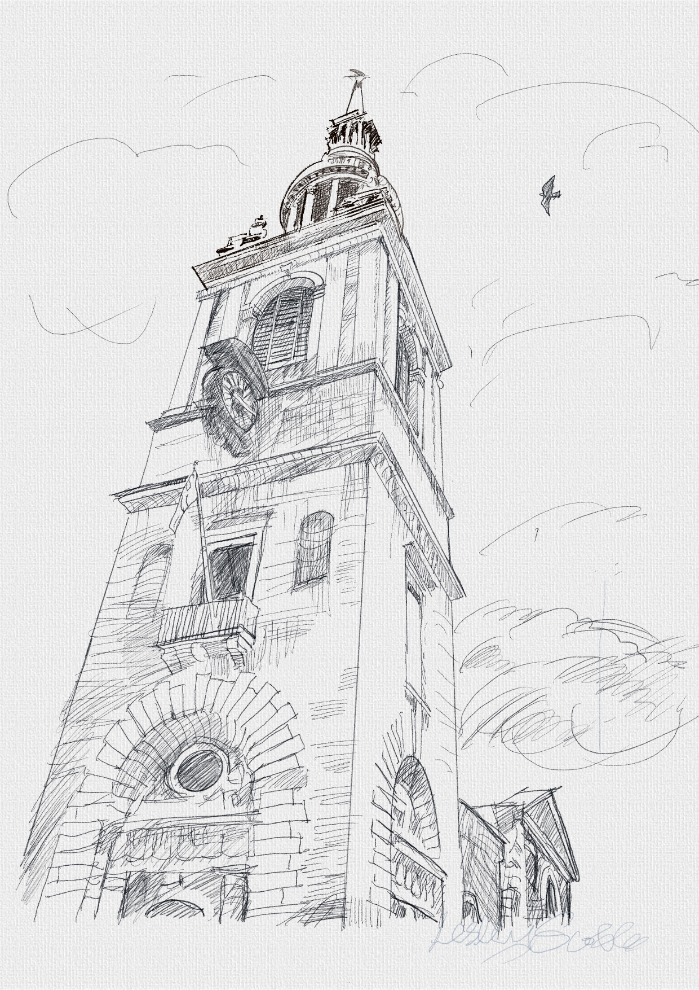
Them Great Bells of Bow

I walk down Cheapside;
I can’t afford a bus ride.

Them bloomin’ bells that ring,
ever so loud!
Them church bells go ding, dong, ding.
But something abaht them makes me proud,
and makes me Cockney ‘eart sing, yer know.
Them great big bells, the great bells of Bow.

I ball and chalk down Cheapside;
I can’t afford a bus ride.

I ball and chalk in the rain,
And again when it’s sunny.

I ain’t got bees and honey,
My money’s all spent.
I need it for me Duke of Kent.
Me weasel’s popped.
Oh, the bells ‘ave stopped.

I walk down Cheapside;
I can’t afford a bus ride.

I love it though,
When I ‘ear them great big bells—the great bells of Bow.
I was born to the sound,
I’m a pearly queen,
Yer know wha’ I mean?

Hells bells! What’s this I see on the ground?
I don’t Adam and Eve it!
A Lady Godiva!
Cor blimey, mate!
I’ve found a fiver!
Oh no, it’s getting late.

I wanna bus ride,
to go down Cheapside.

The bells are ringing loud.
Something abaht them makes me proud.
They go ding, dong, ding.
I sing a song as I walk along down Cheapside,
an’ everything’s alright. Right?
There ain’t a bus ride in sight.
Go stick it up me jacksie!
And I hail a taxi.
~

Lesley Scoble, January 2024
I thought it might be fun to narrate my poem. Here is the recording. Enjoy!
Time lapse video of my ink drawing in progress of St Mary-Le-Bow church.
A little bit about…
NOTES

Born to the sound of Bow Bells
They say that if you are born within the sound of Bow Bells; you are a true Cockney.

Cheapside
Cheapside is a street that runs from the Royal Exchange at the Bank to St Paul’s Cathedral. The church of St Mary-Le-Bow is near the St Paul’s end.

Cheapside in the past was a major marketplace. Cheap comes from an Old English word meaning marketplace. Cheapside’s side streets reflect this in their names, such as Milk Street and Bread Street.

William Shakespeare mentions Cheapside in Henry VI: “All the realm shall be in common, and in Cheapside shall my palfrey go to grass.”
(There is not a lot of grass in Cheapside today, alas.)
~
Index of Cockney Rhyme words in the poem
Ball and chalk = walk
Duke of Kent = rent
Weasel and stoat = coat.
(In the poem I wrote, “Me weasel’s popped.” If you pop the weasel, it means you’ve pawned your coat for money to pay for the drink you’ve drunk in your local pub called the Eagle. The Eagle pub still exists on the City Road.)
Adam and Eve = believe
Lady Godiva = fiver
Jacksie = arse
~
Pearly Queen
Pearly Kings and Queens stem from Victorian London’s working class tradition and still thrive today.

The first Pearly King

An orphan street sweeper, Henry Croft, collected money for charity in the 1870s. He was aware the costermongers (street traders) sewed found mother-of-pearl buttons to their trousers.

Henry adopted the fashion and created a pearly suit decorated with hundreds of mother-of-pearl buttons to attract attention to his cause.

The glitzy outfit gained popularity, and the style wove itself into Cockney culture becoming their traditional national dress.

In 1911, they formed an organised pearly society in North London.

The valued, elaborate pearly costumes pass down from generation to generation.

The great bells at Bow and oranges and lemons
The traditional folk song and nursery rhyme Oranges and Lemons mention the “great bell at Bow”. This is an old children’s street song I remember playing in my childhood. The rhyme mentions only one great bell. There are, in fact, twelve bells of Bow. They cast them at the famous Whitechapel foundry founded in 1570.
When walking past the old Bell Foundry in Whitechapel (just before its closure), I enjoyed peeking through the door and seeing the flames of the foundry and giant metal bells during the process of casting. It was a look back in time.
This historic foundry closed in 2017 after almost 450 years of casting church bells.
Oranges and Lemons
Oranges and lemons,
Say the bells of St. Clement's.

You owe me five farthings,
Say the bells of St. Martin's.

When will you pay me?
Say the bells at Old Bailey.

When I grow rich,
Say the bells at Shoreditch.

When will that be?
Say the bells of Stepney.

I do not know,
Says the great bell at Bow.

Here comes a candle to light you to bed,
And here comes a chopper to chop off your head!
Chip chop chip chop the last man is dead.
.
ACKNOWLEDGEMENT
Thank you, David, The Skeptics Kaddish, for your motivational and inspiring W3 Weekly Poetry Prompt.
Thank you Lorraine, Blindwilderness for choosing my poem, MAYFLIES, as your winner.
My thanks to all the poets who are responding to my prompt. I’ve read some of them already and they are brilliant!
Today (the 5th of January) it is my birthday. I should like to thank you all in advance for any birthday greeting, commiseration, face lifts and large bottles of champagne. 😁 Cheers! 🍾 (or in the words of Robbie Burns Hoots mon the noo!
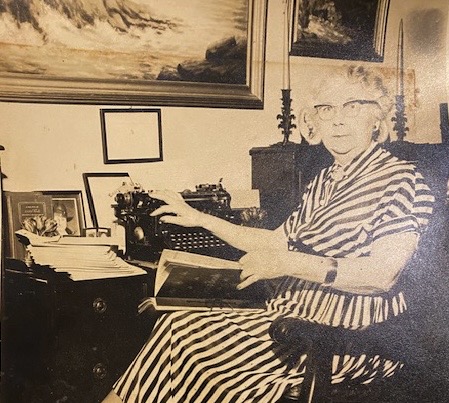
I’ll leave you with my birthday self portrait titled it’s weird being the same age as old people!

Lesley lives in the City of London Square Mile. An artist, actor and sculptor (her first ceramic sculpture won the V&A inspired by… Award). Scenic artist & book illustrator, playwright, (her musical play, Rapscallion performed in inner city schools and theatre school); TV dancer; Animator and illustrator for TV production. Set up Pinecone Studios Ltd and IIMSI Ltd drama and filmmaking workshops in London – producing award-winning films made by children.


 LesleyScoble.com
Leave a reply to lesleyscoble Cancel reply