

This week’s Poet-of-the-Week is Kim Whysall-Hammond, invites us to play and explore. I’m all for that. I love playing and exploring! Her prompt for the W3 Poetry Prompt #163, is to write a poem and then transform it using the N7+ Machine.
What is the N7+ Machine do I hear you ask? The N+7 procedure, invented in 1961 by French poet, Jean Lescure, involves replacing each noun in a text with the seventh one following it in a dictionary. (The French refer to it as the S+7 procedure— Porquoi? Je ne sais pas.) He developed this linguistic technique as part of the Oulipo (Ouvroir de littérature potentielle), a group dedicated to exploring literary constraints and experimental writing.
To read Kim’s prompt guidelines, click below.
Kim’s prompt guidelines
Kim’s prompt guidelines
For this weeks prompt we are going to play and explore!
There are two stages:
First, write a poem full of images, things – perhaps a descriptive poem. You can use any form or no form. My hint is, make sure there are lots of nouns in your poem, ready for part 2!
Second, you are going to play with your poem using a simple poetic technique from the 1960s.
Once you have written your poem, look again at the words you have used. Many of us use the same “word hoard” again and again in our poems, without realising it. Sooo – in a spirit of play and exploration, I give you the N+7 Machine.
Go to this website and enter the text of your poem and it will gift you your poem back, but with 14 different versions. It does so via a dictionary and it simply replaces the nouns with another one a bit further on in the dictionary. No AI involved.
After you submit your text, scroll down and you will see 15 versions of your poem.
Now, you could use one of these whole, or you can take phrases or words from several versions and use them in your original poem to strengthen it. Or maybe one of those altered poems will inspire you to write another completely different poem.
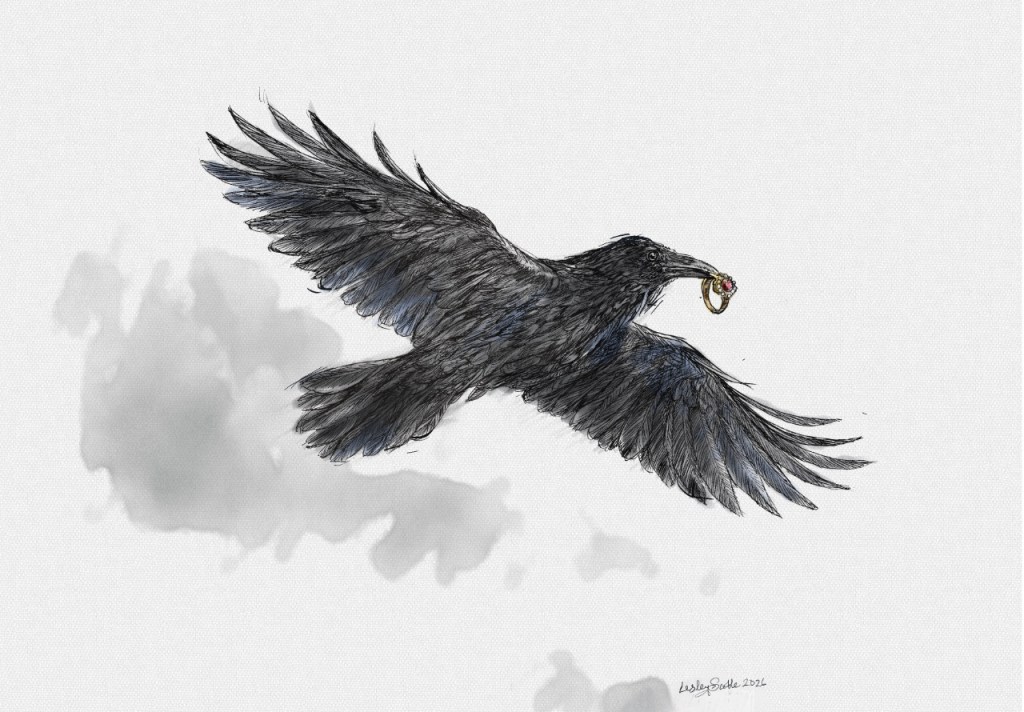
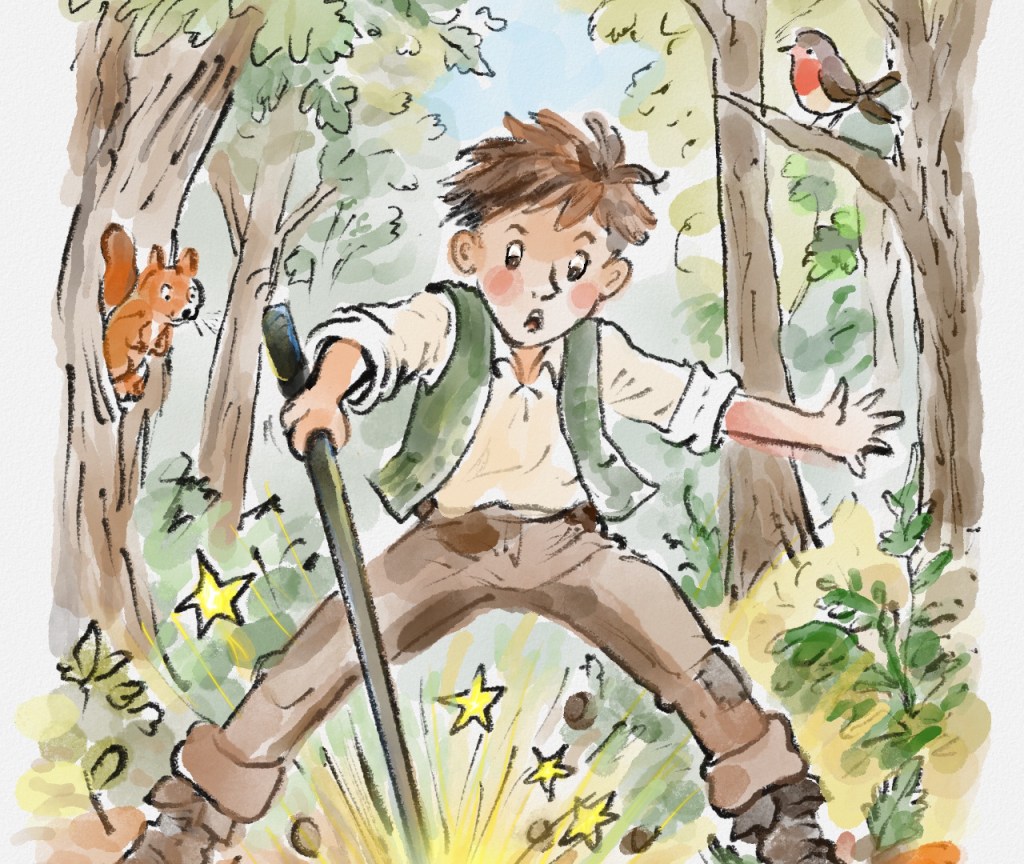
Kim’s prompt was fun! What a joy it was to have a laugh! I even doodled the feature image chuckling at the hilarious results produced by the N7+ machine, which altered my poem in unexpected ways. It makes me wonder if Worzel Gummage or Spike Milligan ever experimented with the N7+ procedure.
I think I might dig out my mother’s old dictionary and try the method myself.
I hope you enjoy a chuckle at my poem, Runaway Dragons & Pocket Triangles, transformed by the N7+ Machine! By the way, I doodled my feature image in Pages—of all things! (My usual app for artwork is Procreate!) I’m avoiding Word on the iPad as it’s misbehaving; it keeps scrolling on its own, making it unusable.
I also hope you enjoy the song interpretation — a surreal, alternate version of my poem Roubles in the Endecagon 🎶 — further down the page.
Runaway Dragons & Pocket Triangles

If you’re slightly curious as to what the original version of the poem was, click below to access my secret folder.
Secret Folder
Books, papers, and stuff, were all piled up,
There was even a saucepan and a broken cup,
I looked and saw to my dismay,
there was even an old dusty plastic pin tray.
What is all this rubbish doing here‽
Let’s chuck it away—from the end of the pier.
You can’t do that! you exclaim.
You can’t be a litter lout
and dump your things;
That would make you a fly-tipper.
Wait—what’s this?
A smelly fish?
Oh no… It’s a kipper!
—Lesley Scoble, June 2025
And finally — I wrote a new, final version of my poem.
I dug out my mother’s old dictionary—and using the N7+ procedure I wrote another version of the poem!

At home, when everyone else had gone to bed, my mother and I would often linger a while with a nightcap—doing the Daily Telegraph crossword, using this dictionary to check the words. Throughout the book are pencilled notes in her elegant shorthand. (She was secretary to the Lord Chancellor, and her shorthand and typing speeds were phenomenal!). I tried emulating her skills, even going on a shorthand course, but typing and shorthand was something I never got the hang of. Even today, my typing is pathetically slow. And shorthand? What is that?
I loved meeting my mother at the Houses of Parliament for lunch—where the ultimate treat for me was being allowed to climb St Stephen’s Tower and stand beneath Big Ben, just behind the clock face. The number six was taller than my five-foot-two frame! I noticed they still used old Victorian pennies to finely balance the clock’s inner workings.
It’s amazing how opening an old book can bring back such treasured memories—the musty smell recalling old tales and countless hours of wordsmithing. I knew this prompt was about play and exploration, but I didn’t expect it to send me on a whole expedition of memories and burying my nose in an old book. Yet here we are.
It’s been quite a while since I last perused a dictionary in book form. The day has vanished!—I’ve spent so long reading it! I kept stumbling on unbelievable new words I’d never encountered before—and I simply had to explore them.
Anyway, enough chitter-chatter—or should I say, chloasma chaunter? (According to the N7+ procedure, courtesy of my mother’s dictionary.)
Hours later… here is the poem, created using the N7+ procedure, with my mother’s beloved old dictionary, The New Imperial Reference Library.
And finally — with the help of my mother’s old dictionary — here is the conclusive version of my poem. And I hope you enjoy the song!
Roubles in the Endecagon
Booses, papists, and stummels, were all piled up,
There was even a saul and a broken cupule,
I looked and saw to my dismay,
There was even an old dusty platband pincer treasure-trove.

What are all these roubles doing here‽
Let’s chuck them away—from the endecagon of the pietá
You can’t do that! you exclaim.
You can’t be a livery lown
and dump your thibles;
That would make you a fodder-tipper.
Wait—what’s this?
A smelly fistular?
Oh no… It’s a kipper!


—Lesley Scoble, June 2025
Song – Roubles in the Endecagon 🎶
Unfamiliar Words?
If some of these words are unfamiliar in this poem—here are some of their definitions.
boose, bouse, booze, n. intoxicating liquor: a drinking bout.
papist, n. an adherent of the pope.
stummel n. the bowl and adjacent part of a pipe.
saul n. soul
cupule n. a small cup in a liverwort containing gemma’s: a cup-shaped envelope on the fruit of some trees, e.g. oak, beech, chestnut.
platband n. a fascia or flat moulding projecting less than its own breadth: a lintel or flat arch: an edging of turf or flowers.
roubles n. the Russian monetary unit.
endecagon, n. a faulty form of hendecagon (someone must’ve dropped their aitch!) hendecagon n. a plane figure of eleven angles and eleven sides.
pietá, n. a representation of the Virgin with the dead Christ across her knees.
lown n. a variant of loon.
thible, thivel, n. a porridge stick (Northern) origin unknown.
fistula n. a narrow passage or duct:an artificially-made opening: a long narrow pipe-like ulcer: a tube through which the wine of the eucharist was once sucked from the chalice.
Did you know that…
tipper, n. is a kind of ale—from Thomas ‘Tipper’ who brewed it in Sussex. (well, I never knew that!)
shittim, n. is the wood of the shittah tree. (well. I never knew that, either!)
My thanks to the Poet of the Week, Kim Whysall-Hammond, for her fun and absorbing prompt.
As always, my gratitude goes to David Bogomolny, of The Skeptics Kaddish, for his motivation and encouragement.
Last, but not least, my thanks to you, the reader, for taking the time to read my poem.
Follow the link below to learn more about the W3 poetry prompts.




Leave a Reply