

This week’s W3 Poetry Prompt (#199) comes from Elizabeth, who is wearing the Poet‑of‑the‑Week laurels (read her winning haiga poem here). She invites us to write a sonnet—either in the Petrarchan or Shakespearean form—to express love for ourselves.
Click here to read Elizabeth’s full prompt guidelines.
Elizabeth’s prompt: Love yourself
February is the month of love. Valentine’s Day has just passed, and many of us marked it by expressing affection for partners, family, and friends. But how often do we turn that same attention inward?
This week, the invitation is simple: write a love sonnet to yourself.
Let this line guide you:
There is in you something that waits and listens for the sound of the genuine in Yourself … that is the only true guide that you will ever have.
— Howard Thurman (1899 – 1981)
A love sonnet is a 14-line poem centered on intense emotion—often romantic love. Here, the beloved is you: your striving, your wounds, your endurance, your becoming.
You may choose one of the two traditional forms:
Petrarchan Sonnet
- 14 lines
- Iambic pentameter
- Each line has 10 syllables, divided into five pairs (called “feet”)
- In each pair, the first syllable is soft (unstressed) and the second is strong (stressed)
- Sounds like da-DUM da-DUM da-DUM da-DUM da-DUM
- Rhyme scheme: ABBAABBA CDECDE or ABBAABBA CDCDCD
- Structure: an octave (8 lines) + a sestet (6 lines)
- A volta (turn) marks the shift into the final section
Shakespearean Sonnet
- 14 lines
- Iambic pentameter
- Rhyme scheme: ABAB CDCD EFEF GG
- Structure: three quatrains (4 lines each) + a closing couplet
- A volta typically occurs before the final couplet
Show some love to yourself!
I set out to write a Shakespearean sonnet—but it seems to have turned into something more like a modern sonnet after Shakespeare. I’ve kept the fourteen-line structure, the ABAB CDCD EFEF GG rhyme scheme, and the ten syllables per line, but my iambic metres appear to wander off whenever they please. If, perchance, you come across any of them, do send them home.
In the meantime, I’m pleased to present—not quite a Shakespearean sonnet—but my first Scoblean sonnet. I hope it gives you a bit of a laugh.
Love Number One
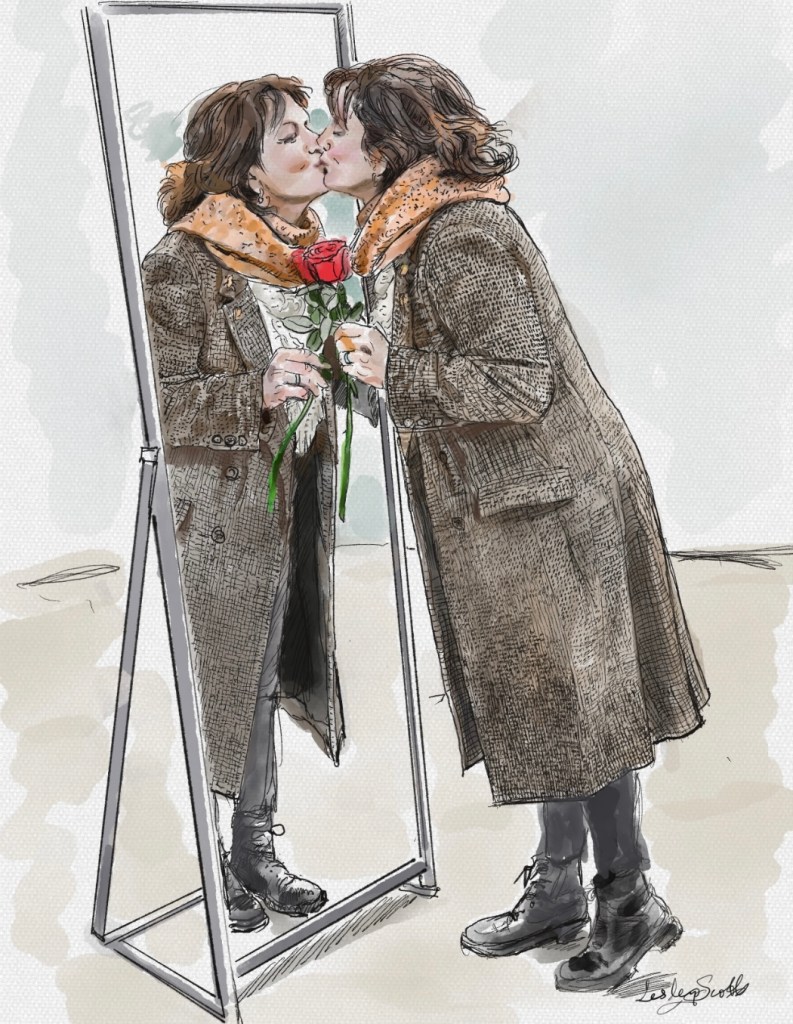
I’m told to love myself as my neighbour,
but how to do that? — my neighbour’s a prat.
Of course, I could do him a big favour,
pretend he’s Brad Pitt — or someone like that.

I can buy me a big bunch of flowers:
red roses, pink tulips, and daffodils;
serenade me on balconies for hours,
drink love potions and assortment of pills.

I’ll look in the mirror, see how I look,
and will scrutinise my visage and say,
“I love you like a hero in a book,
and how beautiful I’m looking today.”

When all’s said and done — I am number one:
I am the stars, the full moon, and the sun.


—Lesley Scoble, February 2026
Audio — Love Number One,
Narrated by me.
Although sonnet means “little song,” it wasn’t originally intended to be sung. It began as an intimate poem, crafted to be spoken aloud or read quietly from the page. So here I am, not singing the words, but giving them voice.
I hope you enjoy this interpretation.
THANK YOU
My thanks as always, to David Bogomolny, for hosting his inspirational poetry platform.
My thanks to Elizabeth for her love yourself sonnet prompt. I am so grateful for the inspiration.
And my thanks to you, dear reader, for spending time with me.




 LesleyScoble.com
Leave a reply to Smitha V Cancel reply