
Um. Er…
A monologue
I hear that I’m forgetful,
and regretful of this fact
by whom
I can’t remember
or by what linguistic pact.

Undoubtedly,
my claim to fame—
forgetful is my middle name—
what my other names might be—
I can’t remember,

Um. Er…

if you know
do tell me so

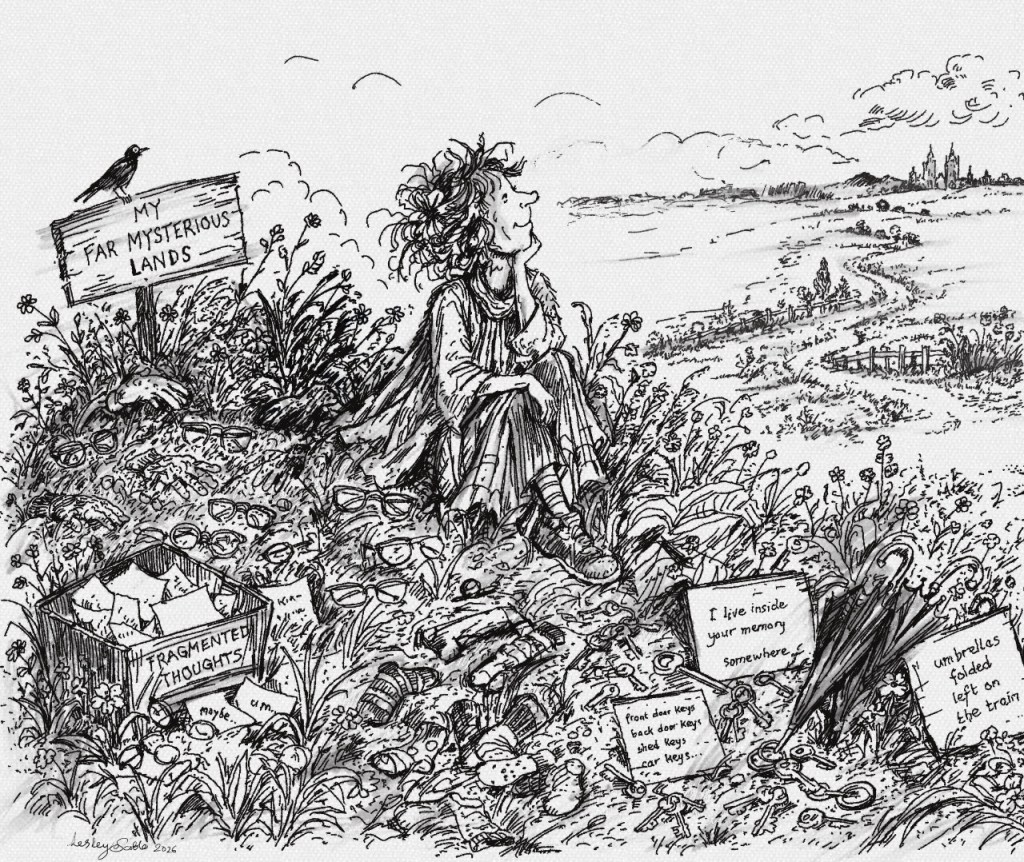
In my far mysterious lands
lie remnant gloves
from ungloved hands
and
‘twixt my swirling grasses’ sigh
millions of reading glasses lie,

among my most treasured finds—
belonging to those who’ve lost their minds—
I hoard fragmented thoughts

frustrated ums and ers,
and huffing from all sorts,

I store odd socks
hoping for a pair—
where is the other one?
where, O where, O where‽

Keys, please
send me more
any door
will do—

front door keys,
cupboard keys, back door keys
keys to the shed—
keys to the car—
are never where one thinks they are,
finding them where they shouldn’t be,
is my secret fantasy

umbrellas folded, left on the train
hundreds of people
getting wet in the rain

in my realm where I reside
I play a game of seek and hide

I live inside your memory
along that long,
long lane…

you will find me there,

but please don’t ask me where.


—Lesley Scoble, 2026
Audio — Um. Er. 🎶
W3 Prompt #235
Dennis Johnstone is W3’s brilliant poet of the week. His prompt encouraged me to write three poems! The first two were micro-poems and failed in the brief. My third attempt is the one here published.
I found the prompt, Giving the Abstract a Voice surprisingly complex. I love the abstract, and it has certainly left me abstracted! Please click Dennis’ Prompt below to discover the guidelines.
Dennis’ prompt: Giving the Abstract a Voice
For this prompt, write a poem that gives an abstract idea a personality, a voice, and a life of its own.
Choose something we cannot physically touch: Destiny, Time, Hope, Justice, Fear, Memory, Regret, Silence, Truth or any other abstract concept that interests you.
Imagine your chosen concept as a character. What might it say? How might it behave? What does it do when nobody is watching? Does it enjoy its work? Does it have ambitions, habits, complaints, prejudices or regrets? Does it understand how its actions affect people?
You are especially encouraged to draw on your own culture, language, mythology, folklore or personal experience to give your character a distinctive identity and voice.
Your personification can be comic, tragic, sinister, tender, absurd, philosophical or anything in between. Perhaps Time is tired of being blamed for everything. Maybe Hope is stubborn. Perhaps Memory keeps things it was asked to throw away.
You might write a dramatic monologue in which the concept speaks directly to us, a conversation between two competing abstractions, a sonnet, an allegory, a satire or something completely different. These are only possibilities, not restrictions.
If you’d like to see one way of approaching the prompt, here is an example I wrote:
Acknowledgement
My thanks to Dennis for providing such an abstraction. I thoroughly enjoyed attempting his prompt.
My thanks as always, to David Bogomolny, without whom, so many poems would remain unwrit.
Last, but by no means least, my thanks to you, the reader, for spending this time with me.




Leave a Reply